
Gaurax
Loew, 1863
Species Guides
9- Gaurax atripalpis
- Gaurax dorsalis(frit fly)
- Gaurax maculicornis
- Gaurax maculipes
- Gaurax melanotum(frit fly)
- Gaurax pallidipes
- Gaurax pseudostigma(frit fly)
- Gaurax shannoni(frit fly)
- Gaurax splendidus
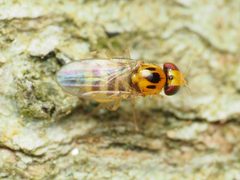
Gaurax is a of small flies in the Chloropidae, established by Loew in 1863. The genus contains approximately 40 described distributed across Europe and the Nearctic region. Most species were described in the mid-20th century by dipterists including Sabrosky, Malloch, and Nartshuk. Chloropidae are commonly known as grass flies or frit flies, though specific ecological associations for Gaurax remain poorly documented.

Pronunciation
How to pronounce Gaurax: /ˈɡaʊræks/
These audio files are automatically generated. While they are not always 100% accurate, they are a good starting point.
Identification
Gaurax are distinguished from other Oscinellinae by combinations of chaetotaxy, wing venation, and genitalic structures. Diagnostic features include specific arrangements of dorsocentral and acrostichal bristles, patterns of dark markings on the and scutellum, and details of the male terminalia. Species-level identification requires examination of microscopic characters and is not reliably possible from photographs alone. The genus is placed in tribe Botanobiini based on morphological synapomorphies.
Images
Distribution
Europe and the Nearctic region. Specific country records include Denmark (DK), Norway (NO), and Sweden (SE).
Similar Taxa
- OscinellaBoth are Oscinellinae with small, dark-colored ; Gaurax typically has more pronounced scutal vittae and different chaetotaxy patterns.
- ElachipteraShares Oscinellinae; Gaurax differs in wing venation details and male genitalia structure.
- BotanobiaCongeneric in tribe Botanobiini; Gaurax generally lack the distinctive facial projections found in some Botanobia.
More Details
Taxonomic history
The has undergone significant revision, with many transferred from other genera or newly described by C.W. Sabrosky in 1951. The authorship is sometimes cited incorrectly; Loew established the genus in 1863 based on European material.
Species diversity
Approximately 40 are currently recognized, with highest diversity in the Palaearctic region. Several species pairs appear to represent synonymies awaiting revision (e.g., G. dubia/dubius).