
Celticecis spiniformis
(Patton, 1897)
Hackberry Thorn Gall Midge
Celticecis spiniformis, commonly known as the hackberry thorn , is a gall-inducing fly in the Cecidomyiidae. The induces distinctive thorn-like galls on hackberry trees (Celtis species). It was first described by Patton in 1897 and is widely distributed across eastern North America where its trees occur.
Pronunciation
How to pronounce Celticecis spiniformis: /ˈkɛltɪˌsiːs ˌspɪnɪˈfɔːrmɪs/
These audio files are automatically generated. While they are not always 100% accurate, they are a good starting point.
Identification
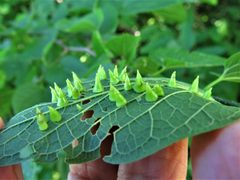
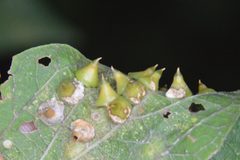
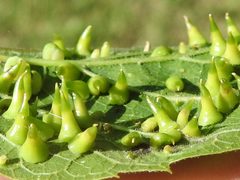
Distinguished from other Celticecis by the elongated, spiniform (thorn-shaped) gall structure rather than rounded or pouch-like galls. The galls of C. spiniformis are narrow, pointed, and often occur in dense clusters on leaf undersides and along , unlike the irregular, wart-like galls of C. capsularis or the rounded, nipple galls of C. celtiphyllia. require microscopic examination for definitive identification.
Images
Appearance
are small, delicate flies typical of gall midges, with long, slender legs and reduced wing venation. The larvae are maggot-like, legless, and develop within the gall tissue. The gall itself appears as a slender, pointed, thorn-like projection emerging from hackberry leaf or petioles, often clustered and ranging from green to reddish-brown depending on age.
Habitat
Associated with hackberry trees (Celtis ), particularly in deciduous woodlands, forest edges, riparian corridors, and urban plantings where trees are present. The species is tied to the presence of its host plant rather than specific abiotic conditions.
Distribution
Eastern North America, ranging from the Great Plains eastward to the Atlantic coast, and from southern Canada through the central and eastern United States. Distribution corresponds closely with the range of Celtis occidentalis and Celtis laevigata.
Seasonality
occurs in spring, coinciding with hackberry leaf flush. Gall development is visible from late spring through summer, with mature galls persisting on fallen leaves into autumn and winter.
Diet
Larvae feed on gall tissue induced on hackberry leaves; the nutritional relationship appears to be utilization of plant tissue modified by the gall induction process rather than direct tissue consumption. do not feed or feeding habits are unknown.
Host Associations
- Celtis occidentalis - gall inductionprimary
- Celtis laevigata - gall inductionprimary
Life Cycle
are deposited on developing hackberry leaves. Larvae induce gall formation and develop within the spiniform structure, feeding on nutritive gall tissue. occurs within the gall. emerge through a small exit hole. The likely has one per year (), with larvae in fallen leaves.
Behavior
Females oviposit on young hackberry foliage, triggering localized plant growth that forms the characteristic thorn gall. Larvae remain sedentary within the gall throughout development. No complex social or patterns have been documented.
Ecological Role
As a gall inducer, modifies plant tissue to create a protected microhabitat and food source for its larvae. The galls may provide shelter for other arthropods, including and . Impact on overall tree health is generally minimal, though heavy may cause localized leaf distortion.
Human Relevance
Occasional nuisance in ornamental hackberry plantings due to unsightly gall clusters. No economic importance; not a pest of cultivated crops. Sometimes used in educational contexts to demonstrate plant-insect interactions and gall induction. No medical or forensic significance.
Similar Taxa
- Celticecis capsularisAlso induces galls on hackberry, but produces irregular, wart-like or capsular galls rather than the slender, pointed thorn galls of C. spiniformis.
- Celticecis celtiphylliaInduces small, rounded, nipple-shaped galls on hackberry leaves, distinct from the elongated spiniform galls of C. spiniformis.
- Celticecis ovataProduces oval or globular galls on hackberry, differing in shape from the thorn-like projections of C. spiniformis.
More Details
Gall Morphology
The spiniform gall is one of several distinct gall types induced by different Celticecis on the same , representing a radiation of gall-forming strategies within the genus.
Taxonomic History
Originally described as Cecidomyiaceltis spiniformis by Patton in 1897, later transferred to the Celticecis. The genus name reflects the association with Celtis (hackberry) plants.