
Celticecis pyriformis
Gagné, 2013
Hackberry Pear-shaped Gall Midge
Celticecis pyriformis is a gall midge in the Cecidomyiidae, described by Gagné in 2013. The species induces distinctive pear-shaped galls on hackberry (Celtis) plants. It is one of several Celticecis species specialized on Celtis species in North America. The species has been documented through iNaturalist observations and taxonomic sources, though detailed biological studies remain limited.
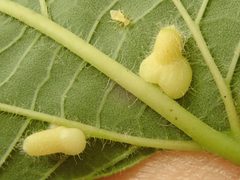
Identification
Distinguished from other Celticecis by the pear-shaped (pyriform) of the galls it produces on hackberry leaves and petioles. The specific epithet 'pyriformis' directly references this shape. Gall shape and association (Celtis species) are primary diagnostic features; are small and require microscopic examination for definitive identification.
Images
Habitat
Associated with hackberry trees (Celtis ), occurring in woodland edges, riparian corridors, and urban plantings where trees are present.
Distribution
North America; distribution corresponds with range of hackberry (Celtis occidentalis and related species), primarily in eastern and central United States.
Host Associations
- Celtis - gall inductionPear-shaped galls formed on leaves and petioles
Ecological Role
Induces gall formation on hackberry, creating specialized microhabitats that may support and .
Human Relevance
Minor significance; gall formation may cause aesthetic damage to ornamental hackberry plantings but does not typically threaten tree health. Provides educational value for observing plant-insect interactions.
Similar Taxa
- Celticecis capsularisAlso forms galls on Celtis, but produces rounded or capsular galls rather than pear-shaped structures
- Celticecis ovataProduces ovoid galls on Celtis; gall shape distinguishes it from C. pyriformis
- Other Celticecis speciesAll induce galls on Celtis; precise gall and microscopic examination of required for -level identification