
Stenodiplosis
Reuter, 1895
Stenodiplosis is a of gall midges ( Cecidomyiidae) comprising small, delicate flies whose larvae develop as seed within grass inflorescences. The genus includes significant agricultural pests, notably *Stenodiplosis sorghicola* (sorghum midge), which attacks grain sorghum and pearl millet. Several have been described from native and grasses in North America, Europe, and Australia, with some under investigation as potential agents.
Pronunciation
How to pronounce Stenodiplosis: //ˌstɛn.oʊ.dɪˈploʊ.sɪs//
These audio files are automatically generated. While they are not always 100% accurate, they are a good starting point.
Identification
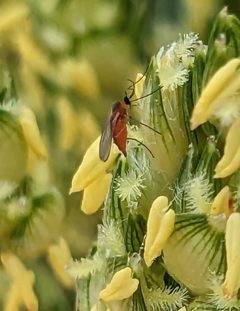
Distinguished from other Cecidomyiidae by combination of small size, orange-red and with yellow , and female ovipositor structure. Separation from closely related genera such as *Contarinia* requires examination of genitalia and antennal segmentation. Specific identification to level depends on plant association, geographic distribution, and detailed morphological examination of and larvae.
Images
Habitat
Grassland and agricultural ; associated with Poaceae including cultivated sorghum, pearl millet, and wild grasses such as johnsongrass (*Sorghum halepense*), *Spartina* , and common reed (*Phragmites australis*).
Distribution
Native to Africa; introduced and established in India, Australia (Northern Territory, Queensland), Greece, and potentially other regions. Multiple occur in North America including eastern South Dakota and coastal North Carolina.
Seasonality
Activity synchronized with plant flowering. In *S. sorghicola*, emerge in spring before commercial sorghum flowering, with peak activity during host anthesis. In Queensland, Australia, greatest occurs November through March. may overlap with multiple cycles per growing season under favorable conditions.
Diet
Larvae are seed , feeding on developing ovules and caryopses of grass . do not feed; energy reserves from larval development sustain brief adult life.
Host Associations
- Sorghum bicolor - primary Grain sorghum; major agricultural pest for *S. sorghicola*
- Pennisetum glaucum - Pearl millet; feeds on developing grains during rainy season
- Sorghum halepense - bridging Johnsongrass; critical and early-season sustaining before commercial crop availability
- Spartina alterniflora - for *S. spartinae*
- Spartina pectinata - for *S. spartinae*; larvae overwinter in dehisced spikelets in soil among rhizomes
- Phragmites australis - for *S. phragmicola*; both native and introduced
- Anisantha tectorum - Cheatgrass; for *S. tectori*, a under investigation for
Life Cycle
Complete with , three larval instars, pupa, and . Eggs laid in flowering spikelets, often under edges of palea and lemma. Larval development 9–11 days; occurs between spikelet glumes or in dehisced spikelets in soil. Adults emerge from pupal cases left protruding from spikelet tips. Under favorable conditions, time 14–16 days; multiple generations per season possible. as larvae in cocoons within fallen spikelets covered with litter, or as larvae in dehisced spikelets in soil.
Behavior
are weak fliers relying on wind currents for . Females lay approximately 50 during single day of adult life. Oviposition occurs specifically during anthesis, with females attracted to host plant volatiles. Adults most abundant along field edges downwind of earlier-flowering hosts. Males and females emerge in daily requiring near-daily sampling for monitoring.
Ecological Role
Seed reducing reproductive output of grass . In natural , through including *Aprostocetus* spp., *Eupelmus australiensis*, *Tetrastichus* spp., and *Tetrastichus bromi*. In agricultural systems, major pest causing significant yield loss; larval feeding prevents kernel development. Serves as host for introduced and native parasitoid guilds. Resource partitioning observed with other seed-feeding insects such as *Aethes spartinana* on *Spartina pectinata*.
Human Relevance
Major economic pest of grain sorghum and pearl millet, particularly in Texas, southern United States, and Australia. Yield losses can be extremely high when uncontrolled. Management relies on early uniform planting to escape peak , elimination of alternate (especially johnsongrass), destruction of to reduce , and applications when exceeded. Some (*S. tectori*) under investigation as agents for cheatgrass management.
Similar Taxa
- ContariniaHistorically included *S. sorghicola* as *Contarinia sorghicola*; separated based on morphological characters including male genitalia and antennal structure
- MayetiolaAnother cecidomyiid containing grass-feeding gall midges; differs in gall formation and specificity patterns
More Details
Taxonomic History
*Stenodiplosis sorghicola* originally described in *Contarinia*; transferred to *Stenodiplosis* based on morphological revisions. Some literature still references the older combination.
Economic Thresholds
In Texas sorghum production, calculated based on control cost, grain value, and number of flowering per acre. Single female can destroy average of 45 kernels; thresholds vary from 0.4 to 2.3 per flowering head depending on field conditions.
Resistance Breeding
Considerable progress in screening and breeding sorghum for resistance; however, some resistance sources have become susceptible in Kenya, prompting investigation of wild *Sorghum* relatives as alternative resistance gene sources.
Sources and further reading
- BugGuide
- Wikipedia
- GBIF taxonomy match
- iNaturalist taxon
- NCBI Taxonomy
- Catalogue of Life
- Insects that feed on developing grain in the head - AgriLife Extension Entomology
- First record of Stenodiplosis sorghicola on sorghum in Greece
- Tritrophic interactions in sorghum, midge (Stenodiplosis sorghicola) and its parasitoid (Aprostocetus spp.)
- Tetrastichinae wasps (Hymenoptera: Eulophidae) associated withStenodiplosisReuter (Diptera: Cecidomyiidae) in eastern South Dakota
- Compensation in grain weight and volume in sorghum is associated with expression of resistance to sorghum midge, Stenodiplosis sorghicola
- Artificial infestation of sorghum spikelets with eggs of Stenodiplosis sorghicola (Coquillett) (Diptera: Cecidomyiidae) by water injection
- A new species of Stenodiplosis (Diptera: Cecidomyiidae) on Spartina grasses (Poaceae) with notes on its biology and its parasitoid Tetrastichus bromi (Hymenoptera: Eulophidae)
- Host‐plant preference and oviposition responses of the sorghum midge, Stenodiplosis sorghicola (Coquillett) (Dipt., Cecidomyiidae) towards wild relatives of sorghum
- Effect of sorghum resistant to Stenodiplosis sorghicola (Coquillett) (Diptera: Cecidomyiidae) on oviposition and development of Helicoverpa armigera (Hübner) (Lepidoptera: Noctuidae)
- A new species of Stenodiplosis (Diptera: Cecidomyiidae) on florets of the invasive common reed (Phragmites australis) and its effects on seed production
- DNA sequence variation in the ITS‐1 rDNA subunit and host relationships in sorghum midge, Stenodiplosis sorghicola (Coquillett) (Diptera: Cecidomyiidae), in Australia
- Seasonal incidence of Stenodiplosis sorghicola (Coquillett) (Diptera: Cecidomyiidae) and its parasitoids on Sorghum halepense (L.) Pers. in south‐eastern Queensland, Australia
- Taxonomic Description of Stenodiplosis tectori n. sp. (Diptera: Cecidomyiidae), a Seed Parasite of Cheatgrass, Anisantha tectorum, Based on Morphological and Mitochondrial DNA Data