
Caryomyia flaticrustum
Gagné, 2008
Hickory Puff Tart Gall Midge
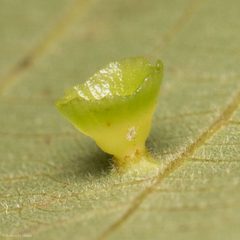
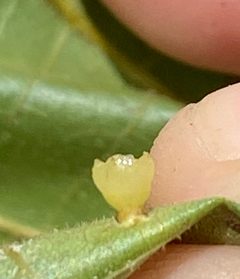
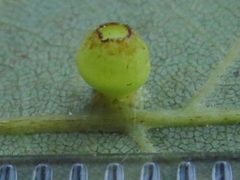
Caryomyia flaticrustum is a gall midge in the Cecidomyiidae, described by Gagné in 2008. The species is known for inducing distinctive galls on hickory trees (Carya species). It is one of several Caryomyia species specialized on hickory . The "Hickory Puff Tart Gall Midge" refers to the characteristic gall produced on host leaves.
Pronunciation
How to pronounce Caryomyia flaticrustum: /ˌkær.i.oʊˈmaɪ.ə flæ.tiˈkrʌs.təm/
These audio files are automatically generated. While they are not always 100% accurate, they are a good starting point.
Identification
Distinguished from other Caryomyia by the specific gall it induces: the "puff tart" gall is a rounded, somewhat flattened structure on hickory leaves. are small, delicate flies with reduced wing venation typical of Cecidomyiidae. Species-level identification of adults requires examination of genitalia or association with the characteristic gall type on known .
Images
Habitat
Deciduous forests and woodlands where hickory trees (Carya ) occur. Galls are found on the leaves of trees, typically in the or on accessible lower branches.
Distribution
Eastern North America, corresponding to the range of its hickory trees. Records indicate presence in areas where Carya are native, including the eastern and central United States.
Seasonality
and gall formation occur during the growing season when hickory leaves are available; specific timing likely synchronized with leaf , though exact dates are not well documented.
Host Associations
- Carya - gall inductionlarvae develop within leaf galls on hickory trees
Life Cycle
Females lay on hickory leaves; larvae induce gall formation and feed within the developing gall tissue. occurs within the gall. emerge to mate and oviposit on new foliage. The likely has one per year, though this is inferred from related Caryomyia species.
Ecological Role
Acts as a gall-forming herbivore on hickory trees. The galls provide sheltered microhabitats that may be utilized by other organisms, including and .
Human Relevance
Of minor economic significance; galls may cause cosmetic damage to hickory foliage but do not typically threaten tree health. Occasionally noticed by naturalists and gall enthusiasts due to the distinctive appearance of the galls.
Similar Taxa
- Caryomyia tubicolaAlso induces galls on hickory leaves; distinguished by gall (tubular versus puff tart shape) and geographic distribution
- Caryomyia caryaecolaAnother hickory-associated Caryomyia ; gall structure and larval chamber arrangement differ