
Caryomyia cucurbitata
Gagné, 2008
Hickory Pumpkin Gall Midge
Caryomyia cucurbitata is a gall midge in the Cecidomyiidae, described by Gagné in 2008. The is known to induce distinctive galls on hickory trees. As a member of the Caryomyia, it belongs to a group specialized on Carya species. The 'Hickory Pumpkin Gall Midge' refers to the characteristic gall .
Pronunciation
How to pronounce Caryomyia cucurbitata: //ˌkæ.ɹi.oʊˈmaɪ.ə kuˌkʊr.bɪˈtɑː.tə//
These audio files are automatically generated. While they are not always 100% accurate, they are a good starting point.
Identification
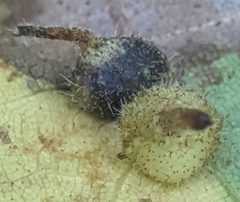
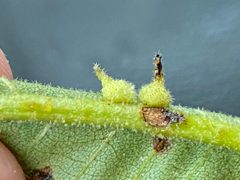
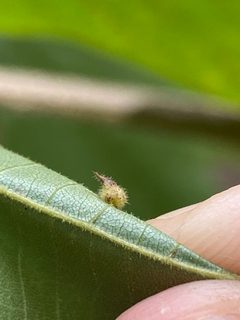
Identified by the unique pumpkin-shaped galls on hickory leaves; galls are rounded, often with longitudinal ridges, and contain a single larval chamber. require microscopic examination for definitive identification; separation from other Caryomyia relies on antennal structure and genitalia .
Images
Appearance
are small, delicate flies typical of Cecidomyiidae, with reduced wing venation and bead-like . Larvae are minute, legless, and maggot-like. The is distinguished by the pumpkin-shaped galls it produces on leaves.
Habitat
Deciduous forests and woodlands where hickory trees (Carya spp.) occur. The is tied to the presence of its plants.
Distribution
Eastern North America, corresponding to the range of hickory . Specific distribution records are limited due to the species' recent description.
Seasonality
and gall formation occur during the growing season when hickory leaves are expanding; exact timing undocumented but presumed to align with spring leaf flush.
Host Associations
- Carya - gall induction ; specific hickory unconfirmed
Ecological Role
As a gall inducer, the modifies plant tissue to create protected larval chambers. This represents a parasitic relationship with the host plant. Galls may provide microhabitats for other organisms, though associations are undocumented for this species.
Human Relevance
No documented economic or agricultural significance. The galls are occasionally noticed by naturalists and foresters but do not cause substantial tree damage.
Similar Taxa
- Caryomyia caryaecolaAlso induces galls on hickory; distinguished by gall —C. caryaecola produces elongate, spindle-shaped galls rather than rounded pumpkin-shaped galls
- Caryomyia tubicolaAnother hickory gall midge; produces tubular or finger-like galls, contrasting with the rounded galls of C. cucurbitata
More Details
Taxonomic history
Described by Raymond Gagné in 2008 based on gall and specimens. The specific epithet 'cucurbitata' refers to the pumpkin-like (cucurbit) shape of the galls.