
Schizomyia racemicola
(Osten Sacken, 1862)
Goldenrod Bunch Gall Midge
Schizomyia racemicola is a gall midge in the Cecidomyiidae that induces characteristic bunch galls on goldenrods (Solidago ). First described by Carl Robert Osten-Sacken in 1862, this species is found in eastern North America. The galls it produces cause dense clusters of stunted leaves at the stem tips, creating a broom-like or "bunch" appearance. The species is relatively well-documented due to the conspicuous nature of its galls on a common plant.
Pronunciation
How to pronounce Schizomyia racemicola: //ˌskɪzoʊˈmɪa rəˈsɛmɪˌkoʊlɑ//
These audio files are automatically generated. While they are not always 100% accurate, they are a good starting point.
Identification
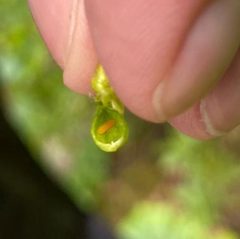
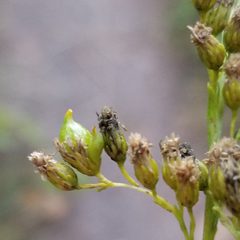
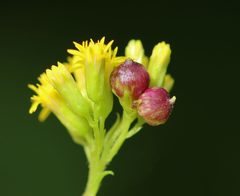
The is minute and difficult to identify without microscopic examination. However, the is readily identified by its distinctive galls: dense, leafy clusters (bunch galls) formed at the meristems of goldenrod stems, typically 2–5 cm in diameter, composed of numerous small, stunted, often reddish or greenish leaves. These galls differ from other goldenrod galls in their terminal position and leafy structure rather than spherical or elliptical form.
Images
Habitat
Associated with goldenrod (Solidago) stands in meadows, fields, roadsides, and open woodlands. Requires plants in early successional or disturbed with adequate sunlight.
Distribution
Eastern North America; confirmed from Vermont and other parts of the United States. Records suggest range broadly coincides with that of its goldenrod in northeastern and north-central regions.
Seasonality
and gall induction occur in spring when goldenrod shoots are elongating. Galls become visible by early summer and persist through the growing season. occurs in the soil or within plant tissue.
Diet
Larvae feed on goldenrod (Solidago) stem tissue, inducing gall formation. Specific Solidago utilized have not been fully documented.
Host Associations
- Solidago - gall inducergoldenrod
Life Cycle
Larvae develop within the bunch galls, feeding on plant tissue. occurs within the gall or in soil. emerge to mate and oviposit on new goldenrod growth. Exact number of per year is undocumented; likely .
Behavior
Females oviposit into goldenrod buds, triggering the plant to produce the characteristic bunch gall. Larval feeding maintains gall structure. are weak fliers and likely disperse short distances.
Ecological Role
Acts as a herbivore and gall inducer on goldenrods. The galls provide microhabitats for and , though specific associated are poorly documented. May influence goldenrod growth form and competitive dynamics in stands.
Human Relevance
Of minor economic importance; galls may reduce goldenrod height and seed production but do not significantly impact agriculture. Occasionally noticed by naturalists due to conspicuous gall structure.
Similar Taxa
- Rhopalomyia solidaginisAlso induces galls on goldenrods, but produces elliptical stem galls rather than terminal bunch galls.
- Eurosta solidaginisInduces spherical stem galls on goldenrods; gall shape and position clearly distinct.
- Other Schizomyia speciesSeveral occur on goldenrods; precise identification requires examination of or molecular analysis.