
Asphondylia rudbeckiaeconspicua
Osten Sacken, 1878
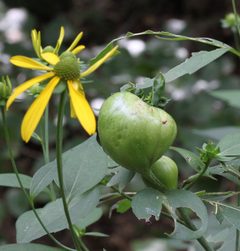
Asphondylia rudbeckiaeconspicua is a gall midge in the Cecidomyiidae, first described by Carl Robert Osten-Sacken in 1878. The larvae induce galls in the flower of cutleaf coneflower (Rudbeckia laciniata), developing within distinct zones of the capitulum tissue. This species serves as to a diverse guild of that exhibit stratified distribution patterns within the gall structure, with different parasitoid species occupying different depth zones.
Pronunciation
How to pronounce Asphondylia rudbeckiaeconspicua: /æsˌfɒnˈdɪliə ruːdˌbɛkiːəˈkɒnˌspɪk.juə/
These audio files are automatically generated. While they are not always 100% accurate, they are a good starting point.
Identification
Galls appear in flower of Rudbeckia laciniata; specific gall and features not described in available sources. Distinguished from other Asphondylia by plant association with Rudbeckia laciniata.
Images
Habitat
Flower (capitula) of cutleaf coneflower (Rudbeckia laciniata); galls induced in capitulum tissue with larvae developing in distinct central and peripheral zones.
Distribution
North America; specific range details not documented in available sources.
Seasonality
Multiple per year suggested by seasonal patterns of occurrence; and oviposition timed with Rudbeckia flowering period.
Diet
Larvae feed on plant tissue within induced galls on Rudbeckia laciniata flower .
Host Associations
- Rudbeckia laciniata - plantcutleaf coneflower; galls induced in flower
- Torymus umbilicatus - occupies specific depth zone within gall
- Ormyrus labotus - occupies specific depth zone within gall
- Eurytoma gigantea - occupies specific depth zone within gall
- Eurytoma obtusiventris - occupies specific depth zone within gall
- Rileya americana - occupies specific depth zone within gall
- Tetrastichus - level identification; of gall midge larvae
- Platygaster - level identification; of gall midge larvae
Life Cycle
Larval development occurs within galls in Rudbeckia laciniata flower ; larvae occupy distinct zones within gall (central vs. peripheral tissue). Multiple per year suggested by seasonal occurrence patterns. occurs within gall; emerge to mate and oviposit into developing flower heads.
Behavior
Induces gall formation in plant flower through female oviposition; larvae develop in stratified zones within galls, creating resource partitioning opportunities for associated guild. Central zone larvae appear to experience lower rates than peripheral zone larvae.
Ecological Role
Acts as for diverse guild; gall formation creates structure supporting multiple parasitoid with partitioning by depth within gall. Contributes to trophic complexity in plant-insect-parasitoid .
Similar Taxa
- Asphondylia ilicicolacongeneric gall midge , but induces galls in holly berries (Ilex opaca) rather than Rudbeckia flower ; differs in plant and gall location
More Details
Parasitoid guild structure
Research has documented that of A. rudbeckiaeconspicua exhibit stratified distribution patterns within galls, with different occupying characteristic positions. This creates a complex structure with partitioning by depth within the gall tissue.
Sources and further reading
- BugGuide
- Wikipedia
- GBIF taxonomy match
- iNaturalist taxon
- Catalogue of Life
- Deck the halls with boughs of holly adorned with cheery red and green berries! Green is good for holly berry midge, Asphondylia ilicicola — Bug of the Week
- Deck the halls with boughs of holly…and the Native holly leafminer, 'Phytomyza ilicicola', and Holly berry midge, 'Asphondylia ilicicola' — Bug of the Week
- Green is good - Holly berry midge, Asphondylia ilicicola — Bug of the Week
- Green is good for holly berry midge, Asphondylia ilicicola — Bug of the Week
- The Insects Behind the Weird Growths on Plants
- Archive — Bug of the Week
- Depth Associations and Utilization Patterns in the Parasitoid Guild of Asphondylia rudbeckiaeconspicua (Diptera: Cecidomyiidae)