
Asphondylia resinosa
Gagné, 1990
Creosote Resin Gall Midge
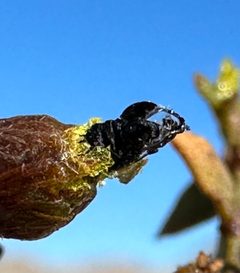
Asphondylia resinosa is a gall midge in the Cecidomyiidae that induces distinctive resinous galls on creosote bush (Larrea tridentata). The was described by Gagné in 1990 and is one of approximately 15 Asphondylia species known to induce galls on creosote bush. Like other gall midges, the larva develops inside the plant tissue, with the gall providing both shelter and nutrition. The specific epithet 'resinosa' refers to the resinous character of the galls it produces.
Pronunciation
How to pronounce Asphondylia resinosa: //æs.fɒnˈdɪl.i.ə ˌrɛz.ɪˈnoʊ.sə//
These audio files are automatically generated. While they are not always 100% accurate, they are a good starting point.
Identification
Asphondylia resinosa can be distinguished from other creosote bush gall midges by the specific of its resinous galls. The galls are characterized by their resinous, often sticky or hardened exudate. Definitive identification requires examination of morphological characters, particularly details of antennal segmentation, genitalia, and wing venation, as the Asphondylia contains numerous with similar adult appearances. The gall structure itself—resinous versus other textures—provides a field diagnostic for distinguishing A. resinosa from other Asphondylia species on creosote bush, such as those producing fuzzy or crystalline galls.
Images
Habitat
Found exclusively in association with creosote bush (Larrea tridentata), which dominates desert scrub in the southwestern United States and northern Mexico. The inhabits warm, arid environments including Mojave Desert, Sonoran Desert, and Chihuahuan Desert . Galls are induced on various parts of the plant, with specific gall location depending on where the female oviposits.
Distribution
Restricted to the range of its plant, Larrea tridentata, in the southwestern United States (southern California, Arizona, New Mexico, southern Nevada, western Texas) and northern Mexico (Sonora, Chihuahua, Baja California). The has been documented in multiple desert regions where creosote bush forms extensive stands.
Seasonality
is tied to plant , with activity likely peaking during periods of active plant growth. In desert environments, this corresponds to spring and summer months following rainfall events, though specific timing varies with local climate conditions. Larvae overwinter within galls, with development resuming in warmer periods.
Host Associations
- Larrea tridentata - Gall inducerCreosote bush; exclusive . Female oviposits into plant tissue, inducing formation of resinous galls in which larvae develop.
Life Cycle
The follows the typical pattern of or multivoltine gall midges. are deposited into creosote bush tissue by the female using her ovipositor. Larvae hatch and feed within the developing gall, which expands to accommodate growth. Larval development proceeds through three instars. Mature larvae either pupate within the gall or exit to pupate in soil. emerge, mate, and females seek new tissue for oviposition. The exact number of per year varies with climate and location.
Behavior
are likely or active during cooler periods of the day to avoid desiccation in arid environments. Females exhibit precise location , identifying suitable oviposition sites on creosote bush. Mating likely occurs shortly after . Larvae are sedentary, feeding continuously within the protective gall tissue. The resinous gall structure may provide defense against desiccation and natural enemies.
Ecological Role
As a gall inducer, A. resinosa manipulates plant growth to create specialized microhabitats. These galls may serve as resources for other organisms, including (guest organisms that inhabit galls) and . The contributes to the complex of gall-forming insects on creosote bush, which includes multiple Asphondylia species and other gall-inducing . The resinous galls may differ in their ecological interactions compared to other gall types on the same host.
Human Relevance
Minimal direct economic or medical importance. The contributes to the biodiversity of desert and may be of interest to researchers studying plant-insect interactions, gall induction mechanisms, and desert . Creosote bush itself has ethnobotanical significance, though A. resinosa specifically is not known to affect human uses of the plant.
Similar Taxa
- Asphondylia auripilaAnother creosote bush gall midge in the same , but induces fuzzy or woolly galls rather than resinous galls. Distinguished by gall .
- Other Asphondylia spp. on creosote bushApproximately 15 Asphondylia are known from creosote bush, distinguished primarily by gall (crystalline, fuzzy, resinous, etc.) and subtle morphological differences.
- Other Cecidomyiidae on LarreaOther gall midge may induce galls on creosote bush; identification requires examination of characters and gall structure.
More Details
Gall morphology
The resinous galls induced by A. resinosa are distinctive among the diverse gall types found on creosote bush. The resinous exudate likely provides physical and chemical protection for the developing larva.
Species diversity on creosote bush
Creosote bush supports an exceptional diversity of gall-inducing insects, with Asphondylia alone representing one of the most species-rich gall midge radiations on a single plant species. This system has been studied as a model for understanding speciation and host- .
Sources and further reading
- BugGuide
- GBIF taxonomy match
- iNaturalist taxon
- NCBI Taxonomy
- Catalogue of Life
- Deck the halls with boughs of holly adorned with cheery red and green berries! Green is good for holly berry midge, Asphondylia ilicicola — Bug of the Week
- Deck the halls with boughs of holly…and the Native holly leafminer, 'Phytomyza ilicicola', and Holly berry midge, 'Asphondylia ilicicola' — Bug of the Week
- Buprestidae | Beetles In The Bush | Page 7
- The Insects Behind the Weird Growths on Plants
- Archive — Bug of the Week
- Bug Eric: March 2009