
Asphondylia auripila
Felt, 1907
Large Creosote Gall Midge
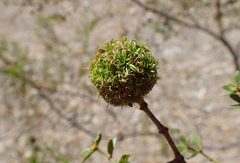
Asphondylia auripila is a gall midge in the Cecidomyiidae that induces stem galls on creosote bush (Larrea tridentata). It is part of a group of 15 closely related Asphondylia species that have partitioned creosote bush ecologically, with different species inhabiting leaves, stems, buds, and flowers. A. auripila specifically occupies the stems, forming distinctive pom-pom-like galls. The larvae develop within these plant-generated structures, which provide both shelter and nutrition.

Pronunciation
How to pronounce Asphondylia auripila: /æsfɒnˈdɪliə ɔːˈraɪpɪlə/
These audio files are automatically generated. While they are not always 100% accurate, they are a good starting point.
Identification
Distinguished from other Asphondylia on creosote bush by its stem gall location and gall . The stem galls appear as dense, pom-pom-like clusters on branches. are morphologically very similar to other members of the A. auripila species group and require expert examination for definitive identification. The gall itself—located on stems rather than leaves, buds, or flowers—is the primary field character for distinguishing this species from its on the same plant.
Images
Habitat
Arid and semi-arid regions dominated by creosote bush (Larrea tridentata), characteristic of Sonoran Desert and Chihuahuan Desert . Found in desert scrub, desert grassland, and transition zones where creosote bush occurs.
Distribution
Southwestern United States and northern Mexico, within the range of its plant Larrea tridentata. Documented in Arizona and adjacent regions based on observation records.
Seasonality
activity and gall formation coincide with creosote bush flowering periods. In southern Arizona, creosote bush blooms in spring (March–April), with gall development continuing through the growing season. Old galls persist on stems and remain visible year-round.
Diet
Larvae feed on nutritive tissue generated by the plant within the gall structure. The specific dietary components of gall midges are not documented for this .
Host Associations
- Larrea tridentata - obligateStem-galling ; induces characteristic pom-pom-like galls on stems. Part of a 15- ecological radiation partitioning different plant organs.
Life Cycle
Females oviposit into creosote bush stems, stimulating the plant to produce abnormal growth (galls). Larvae develop within these galls, feeding on the proliferated plant tissue. Developmental timing is linked to plant , with larval development slowing in winter and resuming in spring. occurs within the gall, with emerging to mate and oviposit during periods of new host plant growth. Specific details of pupal stage duration and voltinism are not documented.
Behavior
Induces gall formation through oviposition activity. The gall provides a protected microhabitat for larval development. are likely short-lived and focused on , as is typical for cecidomyiid gall midges, though specific behavioral observations for this are not recorded.
Ecological Role
Acts as a herbivore that manipulates plant tissue for larval development. Contributes to the diverse of gall-forming insects on creosote bush, representing one of multiple coexisting Asphondylia that partition the host plant by gall location. May influence stem architecture and resource allocation in the host plant, though specific -level effects are not quantified.
Human Relevance
Serves as a subject for studies of ecological speciation and plant partitioning, given the 15- radiation on a single host. The conspicuous stem galls may attract attention from naturalists and photographers in desert regions. No economic importance to agriculture or forestry is documented.
Similar Taxa
- Other Asphondylia species on Larrea tridentata15 closely related form galls on different plant parts (leaves, buds, flowers, stems). A. auripila is distinguished by stem gall location; other species require examination of gall position and for differentiation.
- Asphondylia ilicicolaHolly berry midge that infests fruits of American holly (Ilex opaca); distinguished by plant (holly vs. creosote bush), gall location (berry vs. stem), and geographic range (eastern deciduous forest vs. southwestern desert).
Sources and further reading
- BugGuide
- Wikipedia
- GBIF taxonomy match
- iNaturalist taxon
- NCBI Taxonomy
- Catalogue of Life
- Bug Eric: March 2009
- Bug Eric: More March Bugs
- Deck the halls with boughs of holly adorned with cheery red and green berries! Green is good for holly berry midge, Asphondylia ilicicola — Bug of the Week
- Deck the halls with boughs of holly…and the Native holly leafminer, 'Phytomyza ilicicola', and Holly berry midge, 'Asphondylia ilicicola' — Bug of the Week
- Green is good - Holly berry midge, Asphondylia ilicicola — Bug of the Week
- Green is good for holly berry midge, Asphondylia ilicicola — Bug of the Week