
Dilophus orbatus
(Say, 1823)
March fly
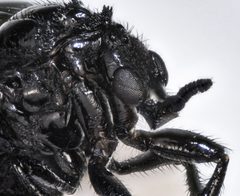
Dilophus orbatus is a of March fly in the Bibionidae, first described by Thomas Say in 1823. The species exhibits pronounced in multiple traits: females are larger with black wings and smaller , while males are smaller with transparent wings and large, nearly conjoined that dominate the . typically emerge in spring. Like other Bibionidae, the larvae are soil-dwelling and feed on decaying organic matter.
Pronunciation
How to pronounce Dilophus orbatus: /dɪˈloʊfəs ɔɹˈbeɪtəs/
These audio files are automatically generated. While they are not always 100% accurate, they are a good starting point.
Identification
Distinguished from the related Bibio by the presence of a ring of shorter teeth on the front tibia rather than long, downcurved spurs. Males are immediately recognizable by their large, contiguous . Females can be identified by their black wings and relatively small size. The combination of in size, wing color, and body size separates this from many other Diptera.
Images
Appearance
are small flies, with females longer than males. Females have black wings that are longer than the male's transparent wings. Males possess disproportionately large, spherical that meet at the top of the (), occupying most of the facial area. Females have smaller relative to head size. The Dilophus is distinguished from the similar genus Bibio by having a ring of shorter teeth on the front legs rather than long, downcurved spurs.
Habitat
are found in terrestrial environments where males form swarms near the ground and low vegetation. Larvae develop in soil, particularly in rich soils containing decaying organic matter, manure, compost, and grass roots.
Distribution
North America; specifically documented in Colorado, California, and Massachusetts based on observation records. The Dilophus includes 15-18 north of Mexico.
Seasonality
emerge in spring, with observations in mid-May documented in Colorado. This timing is typical for March flies (Bibionidae), despite the suggesting March .
Life Cycle
Larvae feed on decaying plant material in soil, and possibly on roots of grasses and herbs. Females use modified front legs to dig into soil several inches deep to deposit in masses of 200-300. Mature larvae likely overwinter, pupating in early spring. are short-lived.
Behavior
Males form large swarms near the ground and low vegetation to which females are attracted for mate selection. Prolonged copulation and post-copulatory guarding by males has been observed in related Bibionidae and may occur in this .
Ecological Role
Larvae function as decomposers in soil , breaking down decaying plant material, manure, and compost. This role contributes to nutrient cycling in soil . Occasional feeding on grass and herb roots may result in minor pest status in some contexts.
Human Relevance
Similar Taxa
- Bibio spp.Also March flies in Bibionidae, but distinguished by long, downcurved spurs on the front tibia rather than the ring of shorter teeth found in Dilophus. Bibio are generally more robust and larger than Dilophus.
- Plecia nearctica (lovebug)Same but famous for prolonged copulation, mass emergences, and automotive hazards in the southeastern United States. Plecia has two with coastal distribution, distinct from Dilophus orbatus.
More Details
Taxonomic history
The Dilophus contains 15-18 in North America north of Mexico. Many Bibionidae species were historically separated based on variable characters such as leg color and hair , leading to taxonomic revisions; male genitalia characters provide more reliable separation.