
Plecia nearctica
Hardy, 1940
lovebug, honeymoon fly, double-headed bug
, commonly known as the or honeymoon fly, is a march fly ( Bibionidae) native to parts of Central America and the southeastern United States. The is renowned for its mass synchronous emergences of , which form conspicuous mating swarms along highways and roads. Males and females remain coupled in copula for 2–3 days, often flying while attached. Adults do not feed and rely entirely on fat reserves accumulated during larval development. The species has expanded its range northward since its original description from Louisiana and Mississippi in 1940.
Pronunciation
How to pronounce Plecia nearctica: /ˈpliːʃiə niˈɑrktɪkə/
These audio files are automatically generated. While they are not always 100% accurate, they are a good starting point.
Identification
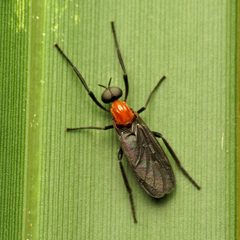
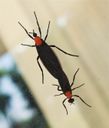
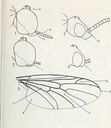
The combination of red and black body distinguishes from most other small flies in its range. Mating pairs in are immediately recognizable and account for the 'double-headed .' The can be separated from the similar Dilophus sayi by geographic range and subtle morphological differences in wing venation and body proportions. Unlike many other bibionids, P. nearctica shows strong attraction to automobile exhaust and forms massive on highways.
Images
Appearance
are small flies, approximately 6–9 mm in length. The body is predominantly black with a distinct red . Males have large, bulbous that nearly meet at the top of the . Females have smaller heads with less prominent . The wings are black and held over the body at rest. When mating, pairs are attached end-to-end, appearing as a single elongated insect with two heads.
Habitat
Larvae develop in soil containing decaying organic matter, including grass clippings, leaf litter, and other decomposing vegetation. are most commonly encountered in open areas near sites, particularly along highways, roadsides, and in urban and suburban environments where lawn debris accumulates. Mass mating swarms form in open, sunny locations.
Distribution
Native to the southeastern United States and parts of Central America. Originally described from Louisiana and Mississippi, the has spread throughout Florida and across the Gulf Coast states. Climate modeling indicates potential for further northward and westward range expansion in the United States by 2050, with suitable predicted for the Gulf Coast, Southeastern, and Western regions under warming scenarios.
Seasonality
Bimodal pattern with distinct spring and fall periods. In Florida, peak emergences occur in May and September. Emergence timing varies geographically and is influenced by temperature and rainfall. Adults are with peak flight activity during warm, humid conditions, particularly mid-morning to early afternoon.
Diet
Larvae feed on decaying organic matter in soil, contributing to decomposition. possess , non-functional mouthparts and do not feed; they rely entirely on stored fat reserves accumulated during larval development. Males transfer to females during copulation, which provide all nutrition required for production.
Life Cycle
Complete with , larva, pupa, and stages. Females oviposit in decaying organic matter. Larval development occurs in soil, feeding on decomposing plant material. occurs in soil. Adults emerge synchronously in large numbers. Adult lifespan is approximately 3–4 days total, with copulation lasting 2–3 days of this period. Females die shortly after oviposition.
Behavior
Males emerge before females and form mating swarms in open areas. Females enter swarms and pair rapidly; copulation begins in and pairs remain physically coupled for 2–3 days. This prolonged copulation functions as mate guarding, preventing rival males from accessing the female. exhibit strong positive attraction to UV-irradiated automobile exhaust fumes, heat, sound, and engine vibrations, causing massive on highways and vehicles. Adults are weak fliers and tend to drift with air currents.
Ecological Role
Larvae function as decomposers, breaking down organic matter in soil . emergences provide a concentrated food source for birds, spiders, and other . Several fungal ( bassiana, Metarhizium anisopliae, lilacinus) have been documented as natural enemies. The has been reported to visit flowers, though its ecological significance as a is considered negligible.
Human Relevance
Considered a significant nuisance pest in the southeastern United States. Mass emergences create hazardous driving conditions when splatter on windshields, reducing visibility. Accumulations on vehicle grilles can clog radiators and cause engines to overheat. Acidic body fluids can damage automobile paint if not removed promptly. Adults may enter homes and buildings. No medical importance—adults do not bite, sting, or . Management strategies include driving during late afternoon or evening when adults are less active, and use of vehicle bras or protective coatings.
Similar Taxa
- Dilophus sayiAnother bibionid fly with similar ; distinguished by geographic distribution and subtle differences in wing venation
- Other BibionidaeMany march flies share general body plan but lack the distinctive red-and-black coloration and highway-associated swarming of P. nearctica
More Details
Mate Guarding Function
Prolonged copulation in P. nearctica has been interpreted as post-copulatory mate guarding. In many insects, the last male to mate before -laying typically fertilizes the majority of eggs. By remaining attached for 2–3 days, males prevent rival inseminations and ensure paternity of offspring.
Climate Change Implications
Modeling studies predict substantial northward range expansion of P. nearctica by 2050 under multiple climate scenarios. This expansion could bring the into contact with new , though current evidence suggests minimal competitive impact on established pollinators.
Historical Range Expansion
First described from Louisiana and Mississippi in 1940, the has undergone dramatic range expansion across the southeastern United States during the 20th century, possibly facilitated by highway construction and lawn maintenance practices that create suitable larval .
Sources and further reading
- BugGuide
- GBIF taxonomy match
- iNaturalist taxon
- NCBI Taxonomy
- Lovebugs, kissing bugs, and other insects engaged in intimate activities. What’s all this coziness about? — Bug of the Week
- Bug Eric: February 2009
- Bug of the Week
- Bugs in love, lovebugs and kissin bugs — Bug of the Week
- Bugs in love: Lovebugs and Kissing bugs — Bug of the Week
- Bugs in love: Lovebugs, kissing bugs, and other insects engaged in intimate activities — Bug of the Week
- Lovebug Plecia nearctica Hardy (Insecta: Diptera: Bibionidae)
- Biology of the "Love-Bug", Plecia Nearctica (Diptera: Bibionidae)
- Reproductive Behavior of the Lovebug, Plecia nearctica (Diptera: Bibionidae)
- A Survey of Fungi Associated with the Lovebug, Plecia nearctica, in Florida
- Tracking the Effects of Climate Change on the Distribution of Plecia nearctica (Diptera, Bibionidae) in the USA Using MaxEnt and GIS