
Dilophus
Meigen, 1803
March flies
Species Guides
9- Dilophus arizonaensis
- Dilophus occipitalis
- Dilophus orbatus(March fly)
- Dilophus serotinus(March fly)
- Dilophus spinipes
- Dilophus stigmaterus(March fly)
- Dilophus strigilatus(March fly)
- Dilophus tibialis
- Dilophus tingi(March fly)
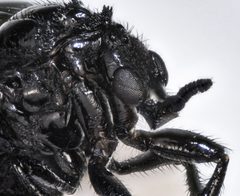
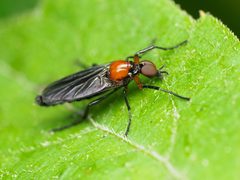
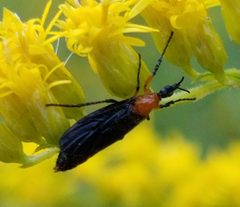
Dilophus is a of march flies (Diptera: Bibionidae) comprising at least 200 described . The genus is distinguished from the related genus Bibio by morphological features of the fore legs. Species occur across multiple continents including North America, Europe, and the Afrotropical region. are typically small to medium-sized flies, often reddish in coloration rather than black.
Pronunciation
How to pronounce Dilophus: /dɪˈloʊfəs/
These audio files are automatically generated. While they are not always 100% accurate, they are a good starting point.
Identification
Dilophus is distinguished from the similar Bibio by the fore tibial armature: Dilophus bears a ring of short teeth, whereas Bibio has two stout, downcurved spurs. Dilophus are also generally smaller, less robust, and more frequently reddish in color than Bibio. Males of both genera have large , while females have smaller relative to body size. In North America, approximately 15-18 species of Dilophus occur north of Mexico.
Images
Appearance
are generally smaller and less robust than Bibio , frequently with reddish coloration. Males possess large, spherical that meet at the top of the ( condition). Females have smaller heads relative to body size. A key diagnostic feature is the presence of a ring of shorter teeth on the fore tibia, in contrast to the long, downcurved spurs found in Bibio.
Habitat
Larvae develop in soil, feeding on decaying organic matter. Specific associations for are poorly documented across the , though they are generally found in terrestrial environments where larval development occurs.
Distribution
distribution with documented in North America (15-18 species north of Mexico), Europe (at least 15 species), and the Afrotropical Ecozone including Madagascar and montane regions of Ethiopia. New species continue to be described, particularly from under-sampled regions.
Seasonality
timing varies by and region. In temperate North America, adults have been observed in mid-spring (May). Afrotropical species show varied related to elevation and regional climate patterns.
Diet
Larvae feed on decaying organic matter in soil, including decaying plant material, manure, and compost. Some larvae feed on roots of grasses and herbs. of at least some do not feed.
Life Cycle
Larvae develop in soil, feeding on organic matter. Females use fore leg modifications to burrow into soil to deposit in masses. Mature larvae likely overwinter, with occurring in early spring. are short-lived in some .
Behavior
Males form aerial swarms to attract females for mating. Swarming involves males gathering in large numbers near the ground and low vegetation. Prolonged copulation has been observed in related bibionid flies and may occur in Dilophus. After mating, females burrow into soil to oviposit.
Ecological Role
Larvae contribute to soil decomposition and nutrient cycling through consumption of decaying organic matter. Occasional pests of cereal crops, vegetables, and rangeland grasses when larval are high.
Human Relevance
Similar Taxa
- BibioVery similar in Bibionidae; distinguished by long, downcurved spurs on fore tibia (versus ring of short teeth in Dilophus), larger and more robust body, and typically black coloration
- PleciaRelated bibionid containing lovebugs; distinguished by different body proportions and notorious swarming in copula that creates human nuisance
More Details
Taxonomic history
The has undergone recent revision in the Afrotropical region, with previous records of Palaearctic D. antipedalis and D. femoratus found to be erroneous and representing undescribed species. Philia splendens has been synonymized with Dilophus bicolor.
Species diversity
At least 200 described exist globally, with ongoing discovery and description of new species, particularly from montane and alpine in Africa and under-sampled regions.
Sources and further reading
- BugGuide
- Wikipedia
- iNaturalist taxon
- NCBI Taxonomy
- Catalogue of Life
- Bug Eric: March Flies in May
- Bug of the Week
- Biology and Reproductive Behavior of Dilophus sayi (Diptera: Bibionidae)
- Revision of the genus Dilophus Meigen, 1803 (Diptera, Bibionidae) from the Afrotropical Ecozone
- Threatening Behavior in the Angle-Headed Dragon, Goniocephalus dilophus (Reptilia, Lacertilia, Agamidae)
- Life cycle of Dilophus okamurae (Phaeophyceae) and its associated invertebrate fauna in Onagawa Bay, Japan
- Updated distribution of Dilophus clavicornus Skartveit & Kaplan, 1996 (Diptera: Bibionidae), with new records from Romania, Montenegro and France