
Bibio
Geoffroy, 1762
march flies, St. Mark's flies
Species Guides
20- Bibio abbreviatus
- Bibio albipennis(White-winged March Fly)
- Bibio alexanderi
- Bibio alienus
- Bibio articulatus(red-legged march fly)
- Bibio atripilosus(March fly)
- Bibio brunnipes
- Bibio femoratus(March fly)
- Bibio holtii
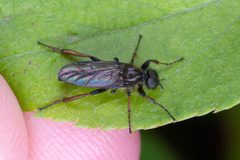
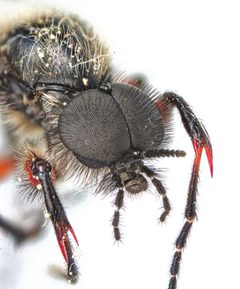
Bibio is a of flies in the Bibionidae, commonly known as march flies or St. Mark's flies. These flies are notable for their spring in large swarms, with males possessing conspicuously large that meet at the top of the ( condition). The genus contains approximately 37 currently recognized in North America, with additional species distributed across the Holarctic region. Several species are known agricultural pests, particularly of cereal crops and grasses.
Pronunciation
How to pronounce Bibio: /ˈbɪ.bi.oʊ/
These audio files are automatically generated. While they are not always 100% accurate, they are a good starting point.
Identification
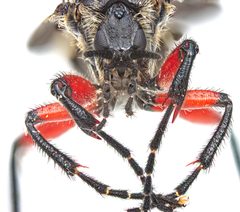
Males are distinguished by large, spherical, that meet dorsally on the . Females have disproportionately small heads relative to body size. A key diagnostic feature is the presence of stout, downcurved spurs on the tibia of the first leg in females, used for digging into soil to deposit . range from 6–12 mm in body length. The can be separated from the similar genus Dilophus by leg armature: Bibio possesses long tibial spurs, while Dilophus has a ring of shorter teeth on the fore legs.
Images
Habitat
are found in open areas where males form swarms near the ground and low vegetation. Larvae develop in rich soils, manure, compost, and decaying organic matter. Some occur in agricultural settings, including highland barley fields at elevations around 3060 m.
Distribution
Holarctic distribution, with documented across North America, Europe, and Asia. North American records include Vermont and other states; European records include Denmark, Norway, and Sweden. Specific collection localities include Haiyan, Qinghai Province, China (100°57′36ʺN, 36°53′39ʺE, 3060 m elevation).
Seasonality
emerge primarily in spring (March–May in temperate regions), with some showing bimodal patterns in spring and fall. The "St. Mark's flies" references emergence around St. Mark's Day (April 25) in Europe.
Life Cycle
Complete with , larval, pupal, and stages. Females deposit eggs in masses of 200–300 several inches deep in soil using fore leg spurs. Larvae feed in soil, likely in mature larval stage and pupating in early spring. Adults are short-lived, with some living only 2–3 days.
Behavior
Males form dense aggregating swarms to which females are attracted for mate selection. Prolonged copulation has been observed, with pairs remaining conjoined for extended periods. of some feed on nectar.
Ecological Role
Larvae function as decomposers, consuming decaying plant material in soils and compost. Some are significant agricultural pests of cereal crops, vegetables, and rangeland grasses, with occasional causing economic damage.
Human Relevance
Several are nuisance pests due to massive spring emergences that splatter vehicle windshields, create hazardous driving conditions, and clog automobile radiators causing overheating. Bibio hordeiphagus is a documented pest of highland barley in China.
Similar Taxa
- DilophusSimilar body plan and , but distinguished by ring of short teeth on fore legs rather than long tibial spurs, generally smaller and less robust body, and frequently reddish coloration
- PleciaAlso in Bibionidae and commonly called "lovebugs"; known for prolonged copulation with pairs flying conjoined, but with different geographic distribution concentrated along Atlantic and Gulf coasts of North America
Sources and further reading
- BugGuide
- Wikipedia
- GBIF taxonomy match
- iNaturalist taxon
- NCBI Taxonomy
- Catalogue of Life
- Bug Eric: March Flies in May
- Bugs in love, lovebugs and kissin bugs — Bug of the Week
- Bugs in love: Lovebugs and Kissing bugs — Bug of the Week
- Bugs in love: lovebugs and kissing bugs — Bug of the Week
- Bug of the Week
- Holarctic distributions in the genus Bibio (Diptera: Bibionidae)
- The complete mitochondrial genome of Bibio hordeiphagus Yang & Luo (Diptera: Bibionidae).