
Bibio necotus
Hardy, 1937
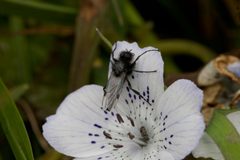
Bibio necotus is a of march fly in the Bibionidae, first described by Hardy in 1937. Like other members of the Bibio, are medium-sized flies that emerge in spring and often form conspicuous mating swarms. Males possess large, that meet at the top of the , while females have disproportionately small heads. The species is part of a diverse North American fauna of approximately 37 currently recognized Bibio species, many of which were historically difficult to distinguish based on external characters alone.
Pronunciation
How to pronounce Bibio necotus: /ˈbɪbi.oʊ nɛˈkoʊtəs/
These audio files are automatically generated. While they are not always 100% accurate, they are a good starting point.
Identification
Bibio necotus belongs to a where -level identification traditionally relied on variable external traits such as leg color and hair , features now recognized as unreliable due to intraspecific variation. Definitive identification requires examination of male genitalia. As with all Bibio species, sexes are readily distinguished: males have large, spherical, that occupy most of the and meet dorsally, while females possess markedly smaller heads with widely separated. All Bibio species bear a pair of stout, downcurved spurs on the tibia of the first leg, a diagnostic -level character that separates them from the similar genus Dilophus, which has a ring of shorter teeth instead.
Images
Distribution
Documented from North America; precise range boundaries for this relative to remain poorly resolved due to historical taxonomic confusion within the .
Seasonality
emerge in spring, with peak activity typically occurring in April and May across most of North America for the .
Life Cycle
Larval stages develop in soil, where they feed on decaying organic matter. Females use their spurred forelegs to dig several inches into soil to deposit in masses of 200–300. Mature larvae likely overwinter, pupating in early spring.
Behavior
Males form dense swarms near the ground and low vegetation to which females are attracted for mate selection. Prolonged copulation and post-copulatory mate guarding by males has been observed in related and may occur in this species as well.
Ecological Role
Larvae function as decomposers in soil , processing decaying plant material and contributing to nutrient cycling. On occasion, larvae may damage roots of grasses, herbs, and agricultural crops including cereals and vegetables.
Similar Taxa
- DilophusLacks the long spurs on forelegs; instead bears a ring of shorter teeth. Generally smaller, less robust, and frequently reddish rather than black.
- Plecia nearcticaThe ',' also in Bibionidae, has distinctive red thoracic coloration and is restricted to Atlantic and Gulf coastal states; are famous for remaining in copula for days and creating automotive hazards.
- Other Bibio speciesApproximately 37 occur in North America north of Mexico; many are externally similar and require dissection of male genitalia for reliable separation.
More Details
Taxonomic History
Bibio necotus was described by Hardy in 1937. The Bibio underwent substantial taxonomic revision, with the number of recognized North American reduced from 53 to approximately 37 following synonymization of many species previously distinguished by variable external characters.
Identification Challenges
Many former '' in Bibio were separated based on leg color, hair , and other characteristics that vary greatly within single species. Real differences exist in male genitalia characters, but these require dissection for observation.