
Bibio femoratus
Wiedemann, 1820
March fly, Lovebug
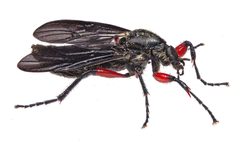
Bibio femoratus is a medium-sized fly in the Bibionidae, commonly known as the March fly or in the southeastern United States. are recognized by their black bodies with orange or red and legs, and a diagnostic dark spot on the leading edge of the wing. The forms conspicuous mating swarms in early spring, with pairs remaining coupled for extended periods. Larvae develop in soil and feed on decaying organic matter.
Pronunciation
How to pronounce Bibio femoratus: /ˈbɪbi.o fɛˈmoʊræ.tʌs/
These audio files are automatically generated. While they are not always 100% accurate, they are a good starting point.
Identification
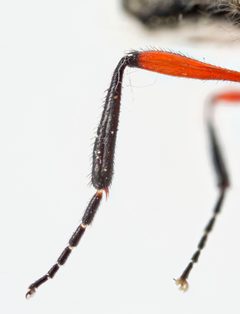
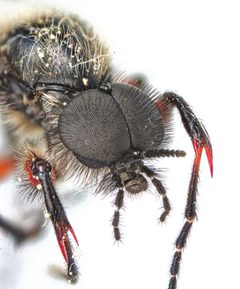
Distinguished from other Bibionidae by the combination of red/orange and legs with black body, plus the dark wing spot on R1. Separated from the similar Dilophus by presence of long, stout, downcurved spurs on the tibia of the first leg (Dilophus has rings of shorter teeth instead). Males distinguished from females by large versus small . Not to be confused with Plecia nearctica, the '' of Florida and Gulf states, which is a different genus with separate spring and fall peaks.
Images
Appearance
are 19-32 mm (3/4 to 1 1/4 inches) in length with a dark brown to black and bright red or orange and legs. The is small and downturned with short, thick, 10-segmented positioned low on the head. Wings possess a distinct dark spot on the R1 (leading edge) approximately two-thirds of the distance from the body. The name refers to the bright red femurs. Females have disproportionately small heads relative to body size; males have large, spherical, that meet at the top of the head.
Habitat
found in open areas near soil surfaces, typically flying within a couple feet of the ground. Larval is soil rich in decaying organic matter, including compost, manure, and grasslands.
Distribution
United States and Canada; abundant in the southeastern United States, especially Gulf Coast states where it is commonly called ''. Records from Vermont and across eastern North America.
Seasonality
emerge in early spring (March-May, with peak abundance varying by latitude). In Colorado and similar regions, extends into mid-May. Larvae develop through fall and winter, pupating in early spring.
Diet
feed on liquids such as water and nectar. Larvae feed on decaying plant matter and organic material in soil; occasionally reported feeding on grass roots.
Life Cycle
Females lay randomly on soil surfaces in masses of 200-300. Eggs hatch into larvae that develop through fall and winter, feeding in soil. Mature larvae likely overwinter, pupating in early spring. emerge synchronously in large numbers. Adult lifespan is brief, estimated at 2-3 days.
Behavior
Forms large copulatory swarms following synchronous . Males gather in that blanket ground and low vegetation; females enter to select mates. Mating pairs remain conjoined at the for hours to days. are slow, clumsy fliers that frequently tumble and flail legs when attempting to right themselves. Show little avoidance response to humans or sudden movements.
Ecological Role
Larvae function as decomposers, breaking down decaying organic matter in soils. serve as through nectar feeding. Form a seasonal food source for during mass emergences.
Human Relevance
Considered a nuisance pest in the southeastern United States due to mass emergences. enter homes, collide with vehicles, and splatter on windshields creating hazardous driving conditions. Large numbers can clog automobile radiators causing overheating. Do not bite or sting. Driving in late afternoon or evening reduces encounters as adults are less active.
Similar Taxa
- Dilophus spp.Similar size and appearance, but distinguished by rings of short teeth on front tibiae instead of long spurs, usually smaller and frequently reddish rather than black.
- Plecia nearcticaAlso called '' and flies coupled, but has separate spring and fall peaks, found primarily along Atlantic and Gulf coasts, and lacks the diagnostic wing spot of Bibio.
- Other Bibio speciesMany former synonymized with B. femoratus; reliable separation requires examination of male genitalia.