
Bibio articulatus
Say, 1823
red-legged march fly
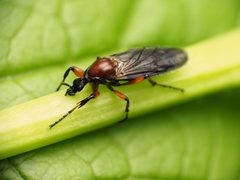
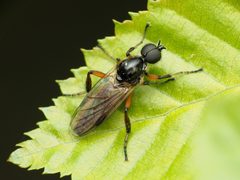
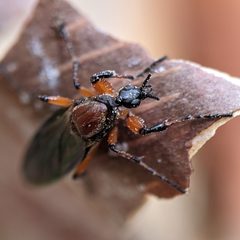
Bibio articulatus is a of march fly in the Bibionidae, commonly known as the red-legged march fly. It is distinguished by its dark ranging from black to deep red and its conspicuous red or orange legs. The species exhibits pronounced , particularly in size and body proportions. It is most active during spring months and is found primarily in the eastern United States.
Pronunciation
How to pronounce Bibio articulatus: /ˈbɪ.bi.oʊ ɑrˌtɪ.kjʊˈleɪ.təs/
These audio files are automatically generated. While they are not always 100% accurate, they are a good starting point.
Identification
Distinguished from similar Diptera by a pair of stout, downcurved spurs at the end of the tibia on the first leg. Separated from the related Dilophus by the presence of long spurs rather than a ring of shorter teeth; Dilophus are also typically smaller, less robust, and more frequently reddish in color. Males are immediately recognizable by their . Females can be distinguished from other Bibio species by the combination of dark body coloration, red legs, and leg spurs.
Images
Appearance
have a dark varying from black to deep red. Legs are distinctly red or orange. Males possess large, spherical that meet at the top of the (), occupying most of the head surface. Females have small, lateral and a proportionally larger body. Females typically display more red coloration on the midsection, while males tend toward black coloration. Males occasionally have clearer wings than females.
Habitat
Found in rotting wood, loose soil, and areas with decaying organic matter. have been observed on plant leaves without causing significant damage. Reproductive activity occurs in loose soil or decaying substrate where females deposit .
Distribution
Eastern United States, from the Rocky Mountains eastward to the Atlantic coast. Records include Vermont and other eastern states.
Seasonality
emerge in March, peak activity occurs during April and May, with becoming by June.
Diet
Larvae feed on decaying plant material in soil, manure, compost, and occasionally on roots of grasses and herbs. feed on nectar.
Life Cycle
Females lay small, oblong in loose soil or decaying substrate, typically in masses of 200-300. Eggs hatch into larvae resembling small, featureless worms. Larvae feed in soil and decaying matter, likely in mature larval stage. occurs in early spring. emerge from pupae with functional wings and reproductive organs. Adult lifespan is brief, approximately 2-3 days.
Behavior
Males form large swarms that blanket ground and low vegetation to attract females. Females use stout tibial spurs to dig several inches into soil to deposit . Prolonged copulation and post-copulatory guarding by males has been observed in related bibionid .
Ecological Role
Larvae function as decomposers, breaking down decaying plant material in soils. Occasional minor pests of cereal crops, vegetables, and rangeland grasses when larval feeding on roots becomes significant.
Human Relevance
Similar Taxa
- Dilophus spp.Similar body plan but distinguished by ring of short teeth on forelegs rather than long spurs; typically smaller, less robust, and more reddish in color
- Plecia nearctica (lovebug)Convergent spring and nuisance swarming, but lovebugs have red and black body with different wing venation; restricted to Atlantic and Gulf coastal states
- Other Bibio speciesMany former '' were synonymized based on variable traits like leg color and hair ; reliable separation requires examination of male genitalia
More Details
Taxonomic history
Many North American Bibio were historically separated based on leg color, hair , and other variable characteristics. Several former species have been synonymized, reducing the recognized count from 53 to approximately 37 species north of Mexico. Bibio articulatus remains a valid, accepted species.
Fossorial adaptation
The enlarged, downcurved spurs on the female forelegs represent a relatively uncommon among North American flies, facilitating deposition in soil.