
Bibio albipennis
Say, 1823
White-winged March Fly
Bibio albipennis, the White-winged March Fly, is a of march fly in the Bibionidae native to North America. are most commonly observed in spring, with males forming conspicuous swarms to attract mates. The species is widespread across the continent and is one of approximately 37 currently recognized Bibio species north of Mexico. Like other bibionids, it plays a role in nutrient cycling through larval feeding on decaying organic matter.
Pronunciation
How to pronounce Bibio albipennis: //ˈbɪbi.oʊ ˌæl.biˈpɛn.nɪs//
These audio files are automatically generated. While they are not always 100% accurate, they are a good starting point.
Identification
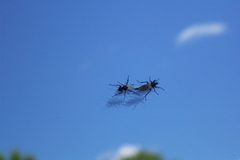
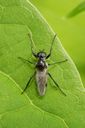
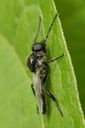
Bibio albipennis can be distinguished from other Bibio by its white or pale wings, as indicated by the specific epithet 'albipennis' (white-winged). Males have large, spherical, that meet at the top of the , while females have disproportionately small heads relative to body size. All Bibio species possess a pair of stout, downcurved spurs at the apex of the tibia on the first leg, a diagnostic feature of the . Species-level identification requires examination of male genitalia characters.
Images
Distribution
Native to North America with a widespread distribution across the continent. Documented from Vermont and other US states.
Seasonality
emerge and are active in spring, with peak activity typically occurring in April and May.
Behavior
Males form dense swarms near the ground and low vegetation to attract females. Females use the stout spurs on their forelegs to excavate soil several inches deep, where they deposit in masses of 200-300.
Ecological Role
Larvae contribute to nutrient cycling and soil formation through feeding on decaying plant material. They function as decomposers in soil .
Similar Taxa
- DilophusAlso in Bibionidae, but possesses a ring of shorter teeth on forelegs rather than long spurs; generally smaller, less robust, and frequently reddish in coloration rather than black.
- Plecia nearcticaFlorida , also Bibionidae; distinguished by red and black body, and by flying in copula for extended periods; restricted to Atlantic and Gulf coastal states.