
Scenopinus fenestralis
(Linnaeus, 1758)
window fly, House Windowfly
Scenopinus fenestralis, commonly known as the window fly, is a small predatory fly in the Scenopinidae. are frequently observed resting on windows of old buildings and outhouses, where their appears relatively inactive. The has been recorded across Europe, including Central Europe and Southern England. Its larvae are notable of clothes moth and larvae.
Pronunciation
How to pronounce Scenopinus fenestralis: //ˌsɛnəˈpaɪnəs ˌfɛnɪˈstreɪlɪs//
These audio files are automatically generated. While they are not always 100% accurate, they are a good starting point.
Identification
Distinguished from other small black flies by its consistent association with windows of older structures and its characteristic inactive resting posture. The Scenopinidae can be separated from similar-appearing brachyceran flies by reduced wing venation and other internal characters; -level identification requires examination of genitalic structures.
Images
Appearance
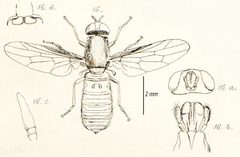
Small, black-bodied fly. exhibit the characteristic compact body form typical of the Scenopinidae, with reduced wing venation.
Habitat
Strongly associated with human structures, particularly old buildings and outhouses. are found on windows, suggesting preference for illuminated surfaces. The ' association with buildings that support of clothes moths and fleas indicates larval includes spaces where these prey occur.
Distribution
Europe, including Central Europe and Southern England. GBIF records confirm presence in Belgium (Flemish Region) and the Azores (Pico, São Jorge, São Miguel).
Diet
Larvae are predatory, feeding on larvae of clothes moths (Tineidae) and fleas (Siphonaptera), as well as other insects. feeding habits are not documented in available sources.
Host Associations
- clothes moths - (larval stage)larvae feed on clothes moth larvae
- fleas - (larval stage)larvae feed on larvae
Life Cycle
Larvae develop as within the spaces occupied by their prey. Specific details of laying, , and developmental timing are not documented in available sources.
Behavior
are described as somewhat inactive, with a strong tendency to rest on windows. This window-associated is the source of both the and the specific epithet 'fenestralis' (Latin for 'of windows').
Ecological Role
Larvae function as agents of domestic pests, specifically reducing of clothes moths and fleas in human-occupied structures.
Human Relevance
Beneficial due to larval on clothes moth and larvae. The 'window fly' and 'House Windowfly' directly reflects its conspicuous presence on windows of human dwellings.
Similar Taxa
- other ScenopinidaeOther window fly share -level characteristics of small size, reduced wing venation, and association with human structures; species separation requires detailed morphological examination
- small black Muscidae or FanniidaeSimilar in general appearance (small, dark, found on windows) but distinguished by wing venation and behavioral traits; Scenopinidae have characteristic reduced venation and more compact body form
More Details
Etymology
The specific epithet 'fenestralis' derives from Latin 'fenestra' meaning window, directly referencing the ' characteristic of resting on windows.
Taxonomic history
Described by Linnaeus in 1758, indicating this was among the earliest dipteran formally described in modern .