
Scenopinidae
window flies
Genus Guides
7Scenopinidae, commonly known as window flies, comprise approximately 400 described of small brachyceran flies distributed worldwide. are typically found on windows in buildings, giving rise to their . The includes three : Caenotinae, Proratinae, and Scenopininae. Larvae are predatory, inhabiting diverse environments from sandy arid soils to decaying organic matter, animal nests, and settings. Two species, Scenopinus fenestralis and S. glabrifrons, have achieved distributions through association with human trade.
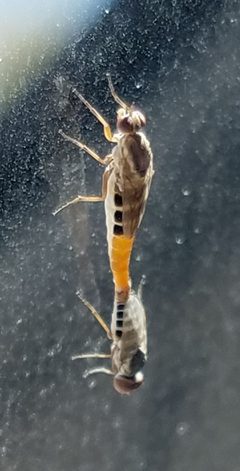
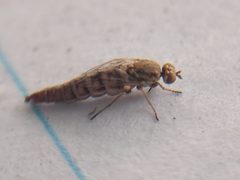
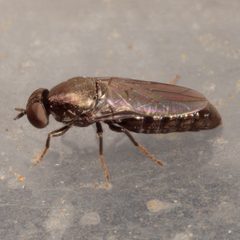
Pronunciation
How to pronounce Scenopinidae: //ˌsiːnəˈpɪnɪdiː//
These audio files are automatically generated. While they are not always 100% accurate, they are a good starting point.
Identification
Scenopinidae can be distinguished from related Therevidae and Bombyliidae by wing venation: the media has only two or three branches (reduced compared to Therevidae), and the radial system is simpler than in Bombyliidae. In most of the family, the stops short of the wing apex, ending at the termination of R5 or M1 (except in Caenotus, where costa extends the full margin). The divides into four branches with R2+3 undivided; the entire radial system is positioned in the half of the wing. R4 terminates on the costal margin, while R5 terminates before or at the wing apex. M1 is always present; M2 is absent in most Scenopininae but present in Proratinae, Cyrtosarthe, and Caenotus; M3 is absent throughout the family; M4 is always present. The marginal is very narrow and opens on the costal margin, as does the submarginal cell. The is pentagonal (quadrangular in Scenopininae).
Images
Appearance
are small insects, usually with body length not exceeding 5 mm. The body is glabrous or slightly hairy with blackish coloration. The has three ocelli. Male are in most , while females are dichoptic. Antennae are pendulous with three segments: two short basal segments and an elongated third segment with a non-annulated . Mouthparts are of the sucking type with a short () bearing a fleshy apex; maxillary palps are one- or two-segmented. The is moderately convex, with mesoscutal bristles present in Proratinae. Legs are short and lack and . Wings overlap on the at rest. The abdomen is large and cylindrical or flattened, with seven visible segments in males and eight in females.
Habitat
Larvae typically inhabit sandy soils of arid environments or dry litter. They also occur in wood, decaying organic substrates, burrows and nests of mammals and birds, and occasionally in domestic environments. In Australia, the is concentrated in hotter, more arid regions including northern Queensland, Northern Territory, and Western Australia. are frequently observed on windows in buildings.
Distribution
Worldwide distribution. The currently holds the most described , though this likely reflects sampling intensity rather than actual diversity. Documented occurrences include North America, South America (Argentina, Chile, Uruguay, Peru), Australia, Europe (including Finland, Sweden, Norway, Denmark), Africa, and Asia. Two species (Scenopinus fenestralis and S. glabrifrons) are , associated with human trade and movement of goods.
Diet
Larvae are predatory, feeding on other soil arthropods and terrestrial arthropods. Specific prey records include stored-grain pests, larvae (clothing moths, food moths), larvae, , dust mites, and fleas. Larvae may prey on other insect larvae including therevid larvae in soil. have sponging mouthparts and feed on nectar and honeydew from open flowers.
Life Cycle
Complete with , larval, pupal, and stages. Larval is poorly known for most . Larvae have been found in association with stored-grain pests, in nests of birds and rodents, in larva burrows in trees and shrubs, and with therevid larvae in soil. Specific details on egg deposition sites, , and time are not well documented.
Behavior
are commonly found at windows in buildings, hence the 'window flies.' Larvae are predatory across all where they occur. Some show tendencies, with larvae adapting to domestic environments to prey on household pests including clothing , food pests, , dust mites, and fleas. The two species have spread through association with human commerce and trade goods.
Ecological Role
Larvae function as of other arthropods in soil and decaying organic matter . In domestic settings, some provide of household pests including , beetles, , mites, and fleas. may contribute to pollination through nectar feeding at open flowers.
Human Relevance
Some are beneficial in domestic environments, where larvae prey on pest insects including clothing , food storage pests, , dust mites, and fleas. The 'window flies' reflects their habit of accumulating at windows in buildings. Two species (Scenopinus fenestralis and S. glabrifrons) have spread globally through human trade, though they are not considered significant pests. The has been studied for its potential in of stored-product and household pests.
Similar Taxa
- TherevidaeSimilar overall and shared infraorder Asilomorpha; distinguished by Scenopinidae having reduced media branches (2-3 vs. more in Therevidae) and different wing venation patterns
- BombyliidaeRelated within Asilomorpha with similar body plans; Scenopinidae have simpler radial wing venation and typically shorter not reaching wing apex
More Details
Systematics
The currently comprises three : Caenotinae ( Caenotus), Proratinae (Acaenotus, Alloxytropus, Caenotoides, Jackhallia, Prorates), and Scenopininae (Belosta, Brevitrichia, Caenoneura, Heteromphrale, Irwiniana, Metatrichia, Neopseudatrichia, Paramonova, Paratrichia, Prepseudatrichia, Propebrevitrichia, Pseudatrichia, Riekiella, Scenopinus, Seguyia, Stenomphrale). The oldest known fossil is Burmaprorates alagracilis from mid-Cretaceous Burmese amber (Myanmar), belonging to Proratinae. The family has undergone significant taxonomic revision, with Prorates and Caenotus previously placed in Empididae and Therevidae respectively before being incorporated into Scenopinidae based on shared .
Research needs
Larval remains poorly known for most . The Nearctic in likely reflects underexploration of other regions, particularly in the tropics and southern hemisphere, where many new species await discovery.
Sources and further reading
- BugGuide
- Wikipedia
- GBIF taxonomy match
- NCBI Taxonomy
- Catalogue of Life
- Publications | Entomology Research Museum
- A review of Australian Scenopinidae (Diptera)
- EIGHTEEN NEW SPECIES OF AUSTRALIAN SCENOPINIDAE (DIPTERA)†
- Occurrence of the Scenopinidae Family in animal droppings (Insecta: Diptera)
- The genus Heteromphrale Kröber, 1937 (Diptera; Scenopinidae) in Peru, with the description of a new species El género Heteromphrale Kröber, 1937 (Diptera; Scenopinidae) en Perú, con la descripción de una especie nueva
- The genome sequence of a window fly, Scenopinus jerei Pohjoismäki & Haarto, 2021 (Diptera: Scenopinidae).
- Scenopinusjerei, a new species of window fly (Diptera, Scenopinidae) from Finland.