
Mydas fulvifrons
Illiger, 1801
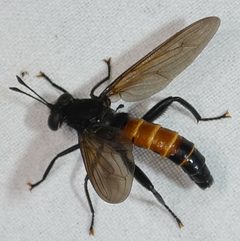
Mydas fulvifrons is a of mydas fly ( Mydidae), a group of large, -mimicking flies related to robber flies. The Mydas contains some of the largest flies in North America. Like other mydas flies, are presumed to be nectar feeders, while larvae are believed to be of woodboring larvae. The specific epithet 'fulvifrons' refers to the tawny or yellowish-brown frontal region of the .
Pronunciation
How to pronounce Mydas fulvifrons: //ˈmaɪ.dəs fʊlˈvɪ.frɒnz//
These audio files are automatically generated. While they are not always 100% accurate, they are a good starting point.
Identification
Mydas fulvifrons can be distinguished from similar large black-and-orange flies by its elongate clubbed (robber flies have short antennae), and from other Mydas by the tawny or yellowish-brown coloration of the frontal region. The species is similar in general appearance to Mydas clavatus, which has red/orange on the second abdominal segment rather than the head.
Images
Habitat
Associated with woodlands and areas where larval (woodboring beetles) occur. have been observed visiting flowers in dry post oak woodland.
Distribution
North America. Specific range details are limited, but the Mydas occurs across eastern and central North America.
Seasonality
active in summer; one observation records an individual in mid-July.
Host Associations
- Woodboring beetle larvae - larval preyBased on known of Mydidae; larvae are believed to be of woodboring larvae in dead wood.
- Eryngium yuccifolium (rattlesnake master) - nectar sourceA related , Mydas tibialis, was observed visiting this plant; M. fulvifrons likely has similar feeding habits.
Life Cycle
Larvae develop as in dead wood, feeding on woodboring larvae. emerge and feed on nectar. occurs within the wood or soil.
Behavior
are and visit flowers for nectar. They are mimics, presumably gaining protection from through resemblance to stinging wasps. Adults are generally wary and difficult to approach closely.
Ecological Role
Larvae act as of woodboring beetles, potentially regulating of these beetles in dead wood. may contribute to pollination while feeding on nectar.
Human Relevance
Generally harmless to humans; the mimicry may cause unnecessary alarm. No economic importance documented. Of interest to entomologists due to large size and mimicry.
Similar Taxa
- Mydas clavatusSimilar large black mydas fly with orange/red markings, but M. clavatus has the colored marking on the second abdominal segment rather than the .
- Mydas tibialisAnother large eastern Mydas with golden legs; distinguished by leg coloration and specific marking patterns.
- Robber flies (Asilidae), particularly Promachus and other large generaSimilar large size and predatory habits, but robber flies have short and are active of other insects rather than nectar feeders.
- Spider wasps (Pompilidae), particularly Anoplius speciesSimilar black-and-orange -mimic appearance, but wasps have a constricted waist and two pairs of wings (flies have one pair plus ).
- Scoliid wasps such as Scolia dubiaSimilar size and coloration with black body and orange markings, but have different wing structure and waist constriction.
More Details
Taxonomic note
The specific epithet 'fulvifrons' (Illiger, 1801) refers to the tawny or yellowish-brown frontal region of the , distinguishing this from with markings on other body parts.
Biology
The of Mydidae is poorly known compared to their relatives the robber flies (Asilidae). Most knowledge of larval habits comes from limited rearing records and extrapolation from better-known such as Mydas clavatus.