
Heterostylum robustum
(Osten Sacken, 1877)
bomber fly
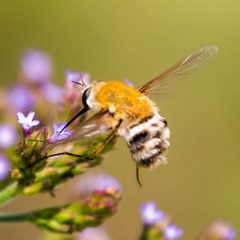
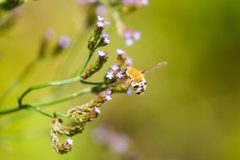
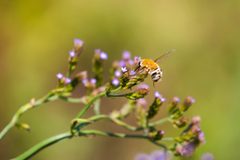
Heterostylum robustum is a parasitic bee fly (Diptera: Bombyliidae) commonly known as the bomber fly. It is a significant of ground-nesting bees, particularly the alkali bee Nomia melanderi, an important of alfalfa in western North America. The exhibits and has a complex involving active larval -seeking and underground. Its parasitic strategy involves launching into host nests rather than direct contact with hosts.
Pronunciation
How to pronounce Heterostylum robustum: /hɛ.tɛ.roʊˈstaɪ.ləm roʊˈbʌs.təm/
These audio files are automatically generated. While they are not always 100% accurate, they are a good starting point.
Identification
Distinguished from other bee flies by its specific association with alkali bee nesting . can be identified by the combination of unclouded wings, tan , gray and buff abdominal patterning, and long . in structure ( males, dichoptic females) and size (females larger) aids identification. The presence of pupal cases attached to ground at sites indicates local .
Images
Habitat
Associated with nesting of ground-nesting bees, particularly the alkali bee Nomia melanderi. Found in sandy or saline soils where bees construct underground nests. Requires open ground for larval burrowing and host-seeking activities.
Distribution
Southwestern Canada, most of the western United States, and Mexico. Distribution corresponds closely with that of its principal , the alkali bee Nomia melanderi, which occurs across Washington, Oregon, Idaho, and Wyoming.
Seasonality
emerge in spring approximately 10 days before , with activity overlapping host nesting season by several weeks. are laid in spring before winter. Larvae overwinter underground, digging upward from 5-10 inches depth to 2-3 inches below ground surface to form winter chambers.
Diet
Larvae are that consume provisions and host larvae. Fourth instar larvae feed for 3-4 days, approximately doubling in size. In some Utah , larvae may leave the first host burrow after partial consumption and seek additional prepupal bees, consuming about half of each. feeding habits are not documented.
Host Associations
- Nomia melanderi - principal alkali bee, important alfalfa
- Nomia nevadensis bakeri - solitary
- Dieunomia triangulifera - solitary
- Calliopsis anthidia - solitary
- Nomia scutellaris - solitary
- Halictus rubicundus - solitary
Life Cycle
incubate 8-11 days in laboratory conditions. First instar larvae are active that move by grasping surfaces with mouth hooks and pushing with . They pass quickly through an inactive second instar and a longer, helpless soft third instar before reaching the fourth instar, when parasitization begins. Fourth instar larvae attach to larvae with and penetrate host flesh with minute mouth hooks. Multiple larvae may cannibalize each other if placed together. Larvae overwinter in oval chambers dug 2-3 inches below ground surface, emerging the following spring.
Behavior
display territorial at sites, with males defending airspace against other males. Females oviposit by launching into nests without touching the ground. After emergence, adults crawl to nearby objects and wait approximately 10 minutes for wings to dry, during which they are vulnerable to . Fourth instar larvae are notably active compared to other parasitic larvae, capable of reattaching to hosts or finding new hosts if disturbed. Larval burrowing involves gyrating the to pack dirt behind and gyrating the to loosen dirt ahead.
Ecological Role
Significant of the alkali bee Nomia melanderi, a commercially important of alfalfa. rates vary regionally from less than 5% to over 90%, with typical rates of 20-40% in many areas. Has reduced formerly abundant alkali bee to insignificant levels in some regions. Acts as a population regulator of bees, with potential cascading effects on alfalfa seed production.
Human Relevance
Considered an agricultural pest due to its impact on the alkali bee, which is managed as a commercial for alfalfa seed production. by H. robustum can substantially reduce alkali bee , affecting crop yields. No direct human interactions or medical significance documented.
Similar Taxa
- Other Heterostylum speciesShared characteristics including bee fly and parasitic lifestyle; distinguished by specific associations and geographic distribution
- Other Bombyliidae parasitoids of ground-nesting beesSimilar ecological role and ; H. robustum distinguished by its specific association with Nomia melanderi and its unique 'bomber' -laying without ground contact
More Details
Agricultural impact variation
rates show extreme regional variation: over 90% in Cache Valley, Utah, versus less than 5% near Wapato, Washington. This variation may reflect differences in nesting , soil conditions, or local .
Host survival strategies
The alkali bee persists despite high through two main mechanisms: some individuals nest solitarily rather than in , and some nest late or produce a small 'second ' in late August that escapes peak activity.
Larval feeding unknowns
As of 1973, the food source for first through third instar larvae prior to parasitization was unknown. These stages may absorb nutrients through the or consume microorganisms in the soil.
Sources and further reading
- BugGuide
- Wikipedia
- GBIF taxonomy match
- iNaturalist taxon
- Catalogue of Life
- New oviposition behaviour spotted in parasitoid wasp | Blog
- Uncategorized | Blog - Part 47
- Saving St Helena’s Bugs on the Brink: Building the Capability of a Budding Conservationist - Buglife Blog - Buglife
- Pensoft blog - Part 153
- Pensoft Editorial Team | Blog - Part 152
- The Biology of Heterostylum Robustum (Diptera: Bombyliidae), A Parasite of the Alkali Bee1