
Bombylius helvus
Wiedemann, 1821
Bombylius helvus is a North American bee fly first described by Christian Rudolph Wilhelm Wiedemann in 1821. As a member of the Bombyliidae, it shares the characteristic -mimicking appearance and parasitic larval typical of this diverse group of flies. The species belongs to the Bombylius, which is distinguished from related genera such as Systoechus by wing venation characters including the position of the r-m .
Pronunciation
How to pronounce Bombylius helvus: /bɒmˈbɪliəs ˈhɛlvəs/
These audio files are automatically generated. While they are not always 100% accurate, they are a good starting point.
Identification
can be distinguished from the related Systoechus by the position of the r-m on the wing. Members of Bombylius are generally active in spring, whereas Systoechus tend to be active in fall. Specific diagnostic features for B. helvus versus other Bombylius species are not documented in available sources.
Images
Habitat
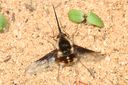
Open sandy areas including sand prairie remnants. have been observed resting on sandy ground.
Distribution
North America. Specific range details beyond continent-level are not documented in available sources.
Seasonality
Spring activity period, consistent with the -level pattern where Bombylius are typically spring-active.
Similar Taxa
- Bombylius mexicanusSimilar appearance and spring activity pattern; both belong to Bombylius and share the characteristic wing venation and -mimicking . B. mexicanus has been documented from sand prairie in Missouri.
- Systoechus speciesSimilar overall bee fly , but distinguished by wing venation (position of r-m ) and typically fall rather than spring activity.
Sources and further reading
- BugGuide
- Wikipedia
- GBIF taxonomy match
- iNaturalist taxon
- Catalogue of Life
- Beware the bee fly - Bombylius sp. — Bug of the Week
- One-Shot Wednesday: Upside down bee fly | Beetles In The Bush
- Bug Eric: Fly Day Friday: Greater Bee Fly
- Bug Eric: Bee Flies
- Diptera | Beetles In The Bush | Page 5
- Bombyliidae | Beetles In The Bush | Page 2