
Poecilanthrax poecilogaster
(Osten Sacken, 1886)
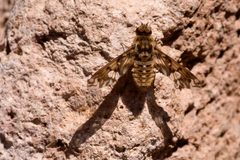
Poecilanthrax poecilogaster is a of bee fly in the Bombyliidae, described by Osten Sacken in 1886. The Poecilanthrax is strictly North American, with the greatest diversity in the Great Basin region. Like other members of this genus, P. poecilogaster likely develops as a of noctuid caterpillars, though specific records for this species remain unconfirmed. are typically observed visiting flowers or perching on vegetation in open, sunny .
Pronunciation
How to pronounce Poecilanthrax poecilogaster: //ˌpiːsɪˈlænˌθræks ˌpiːsɪloʊˈɡæstər//
These audio files are automatically generated. While they are not always 100% accurate, they are a good starting point.
Images
Habitat
Open, sunny including grasslands, prairies, and scrublands. are often found in association with flowering vegetation.
Distribution
North America. Records from iNaturalist indicate observations across the western and central United States, consistent with the 's concentration in the Great Basin region and surrounding areas.
Behavior
are and frequently observed perching on flowers or low vegetation. Like other Poecilanthrax , they are likely strong, fast fliers with agile maneuvering capabilities.
Ecological Role
As a member of the bee fly Poecilanthrax, this likely functions as a of noctuid caterpillars, contributing to natural of these herbivores. The genus is known for parasitizing cutworms and armyworms.
Similar Taxa
- Poecilanthrax luciferConspicuous black and yellow tomentose abdominal crossbands and yellow/tan wing distinguish P. lucifer from P. poecilogaster and other .
- Other Poecilanthrax speciesMany in this require careful examination of wing venation patterns, abdominal coloration, and tomentum distribution for accurate identification.