
Poecilanthrax arethusa
(Osten Sacken, 1886)
Poecilanthrax arethusa is a of bee fly in the Bombyliidae. As a member of the Poecilanthrax, it is likely a whose larvae develop within caterpillars, though specific records for this species are not well documented. Bee flies in this genus are typically in natural . The species was described by Osten Sacken in 1886.
Pronunciation
How to pronounce Poecilanthrax arethusa: //ˌpiːsɪˈlænθræks ˌarɪˈθjuːsə//
These audio files are automatically generated. While they are not always 100% accurate, they are a good starting point.
Identification
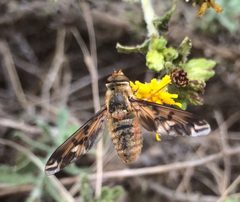
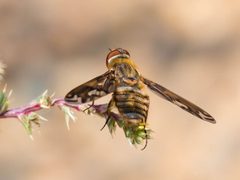
Identification of Poecilanthrax arethusa requires examination of wing venation patterns, abdominal coloration, and tomentose (woolly hair) banding. Within the Poecilanthrax, are distinguished by details of wing coloration, particularly the coloration of major wing and abdominal banding patterns. Specific diagnostic features for P. arethusa relative to such as P. lucifer (which has conspicuous black and yellow abdominal crossbands and yellow or tan bases on larger wing veins) are not documented in available sources.
Images
Distribution
The distribution of Poecilanthrax arethusa has not been specifically documented in available sources. The Poecilanthrax is strictly North American in distribution, with greatest abundance in the Great Basin region, ranging from Canada south through Central America.
Life Cycle
Based on -level characteristics, Poecilanthrax are likely (one per year) in natural , though some species that frequent agricultural areas may become facultatively or multivoltine due to extended seasonal availability of caterpillars.
Ecological Role
As a member of the bee fly Poecilanthrax, this likely functions as a of caterpillars, contributing to of its species. bee flies are that visit flowers for nectar.
Human Relevance
Poecilanthrax arethusa has no documented direct economic importance to humans. Related in the , such as P. lucifer, have been studied for their potential as agents of agricultural pest caterpillars including fall armyworm (Spodoptera frugiperda), with reported rates up to 25%.
Similar Taxa
- Poecilanthrax luciferSimilar size and general appearance as congeneric bee flies; distinguished by specific wing venation coloration and abdominal banding patterns
- Other BombyliidaeBee flies share general body plan with stout, furry bodies and long ; Poecilanthrax distinguished by specific wing and abdominal patterns
More Details
Taxonomic note
The Poecilanthrax was last revised by Painter & Hall in 1960, at which time it contained 35 . The genus name derives from Greek 'anthrax' meaning charcoal, referring to the often black coloration of flies, not the anthrax.