
Exoprosopa brevirostris
Williston, 1901
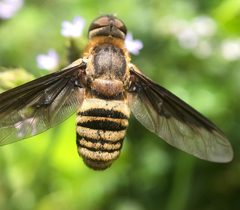
Exoprosopa brevirostris is a of bee fly in the Bombyliidae, first described by Williston in 1901. The species belongs to the Exoprosopa, a diverse group of bee flies characterized by their robust, often -mimicking appearance. Like other members of the family, are nectar feeders and larvae are . The specific epithet 'brevirostris' refers to a short rostrum (snout), a distinguishing feature of this species.
Pronunciation
How to pronounce Exoprosopa brevirostris: //ˌɛk.soʊˈpɹoʊ.sə.pə ˌbrɛv.ɪˈɹɒs.tɹɪs//
These audio files are automatically generated. While they are not always 100% accurate, they are a good starting point.
Identification
The specific epithet 'brevirostris' (short rostrum) indicates a relatively short compared to other Exoprosopa , which often possess elongated rostrums. typically display the robust, hairy body form common to bee flies, with coloration and patterning that provides mimicry. Precise diagnostic features require examination of wing venation, body proportions, and genitalic structures.
Images
Distribution
Documented observations exist across multiple regions, with 323 records on iNaturalist indicating a known range, though specific geographic boundaries are not detailed in available sources.
Diet
feed on nectar from flowers. Larvae are , though specific records for this are not documented in available sources.
Life Cycle
Complete with , larva, pupa, and stages. Larvae develop as , though specific organisms and developmental details for this are not documented.
Ecological Role
may contribute to pollination through nectar feeding. Larvae function as , potentially regulating of insects.
Similar Taxa
- Other Exoprosopa speciesDifferentiated primarily by rostrum length; E. brevirostris possesses a notably shorter than most , which typically have elongated rostrums adapted for accessing deep floral tubes.
More Details
Taxonomic note
The name 'brevirostris' directly describes a morphological trait (short rostrum) that distinguishes this species within its .