
Anthrax vierecki
(Cresson, 1919)
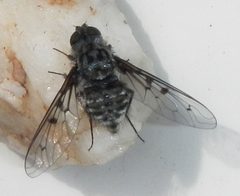
Anthrax vierecki is a of bee fly in the Bombyliidae, first described by Cresson in 1919. As a member of the Anthrax, it belongs to a group of flies whose larvae are known to attack the larvae of other insects, including tiger beetles and solitary bees. The genus is characterized by distinctive wing venation and parasitic strategies.
Pronunciation
How to pronounce Anthrax vierecki: /ˈæn.θræks viˈɛr.ɛ.ki/
These audio files are automatically generated. While they are not always 100% accurate, they are a good starting point.
Identification
-level identification of Anthrax vierecki requires examination of wing venation, particularly the position of the r-m , and subtle differences in body coloration and patterning. Within the Anthrax, species are distinguished by wing markings, abdominal coloration, and microscopic features of the and genitalia. Accurate identification to species typically requires reference to taxonomic keys and comparison with .
Images
Habitat
As with most Anthrax , A. vierecki is associated with open, sandy or sparsely vegetated where insects construct burrows. The is frequently encountered in sand prairies, barren clay areas, and other environments supporting ground-nesting insects.
Distribution
Specific distribution records for Anthrax vierecki are sparse. The has been documented in North America based on limited collection records. Precise range boundaries remain poorly defined due to taxonomic challenges and under-collection of this group.
Seasonality
activity patterns for Anthrax vierecki have not been specifically documented. Related in the Bombylius tend toward spring activity, while other bee fly genera such as Systoechus are more active in fall.
Host Associations
- Unknown - Larvae of Anthrax are of ground-nesting insects. For A. vierecki specifically, records have not been published. Related species in the attack tiger larvae () and solitary bees (Halictidae, Colletidae, Andrenidae).
Life Cycle
The of Anthrax vierecki follows the typical pattern for Anthracinae bee flies. females deposit near or within burrows. First-instar larvae locate and attach externally to host larvae, feeding as ectoparasitoids. Development proceeds through multiple larval instars, with the final instar consuming and killing the host before pupating in the soil.
Behavior
of Anthrax are rapid, agile fliers that frequent flowers to obtain nectar. Females exhibit specialized oviposition , flying backward and downward while thrusting the forward to deposit near burrow entrances. This behavior was first documented for Anthrax analis parasitizing tiger beetles.
Ecological Role
Human Relevance
No direct human relevance has been documented for Anthrax vierecki. The Anthrax has minor significance in research due to its of some pest , though most are not economically important.
Similar Taxa
- Anthrax analisExternally similar bee fly with documented of tiger larvae; distinguished by subtle differences in wing venation and abdominal patterning
- Anthrax georgicusAnother North American Anthrax with similar and ; previously synonymized with A. analis and difficult to distinguish without detailed examination
- Bombylius speciesSimilar -like appearance and flower-visiting , but distinguished by different wing venation patterns and larval (Bombylius larvae are of solitary bee nests but differ in attachment behavior)
More Details
Taxonomic History
Anthrax vierecki was described by Ezra Townsend Cresson in 1919. The Anthrax has undergone significant taxonomic revision, with many historically confused due to subtle morphological differences and variable coloration.
Research Significance
The Anthrax is among the best-studied bee fly genera regarding associations, due to the economically and ecologically significant hosts (tiger beetles and solitary bees) attacked by several . Anthrax vierecki represents one of approximately 70 Anthrax species for which host records remain unknown.
Sources and further reading
- BugGuide
- GBIF taxonomy match
- iNaturalist taxon
- Catalogue of Life
- Bombyliidae | Beetles In The Bush | Page 2
- ID Challenge #11 | Beetles In The Bush
- Ground nesting bees beware of the bee fly: Bombyliidae — Bug of the Week
- Danger afoot for ground nesting bees: Look out for bee flies, Bombyliidae — Bug of the Week
- Bug Eric: The Stable Fly