
Anthracini
Genus Guides
3- Anthrax(Charcoal Bee Flies)
- Dicranoclista
- Xenox(Tiger Bee Fly)
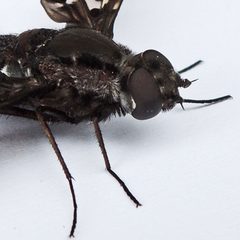
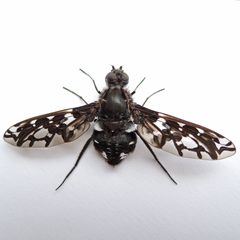
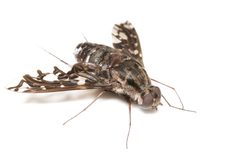
Anthracini is a tribe of bee flies within the Bombyliidae, Anthracinae. The tribe contains at least nine , with Anthrax being the most -rich and well-studied. Members are primarily known as , with larvae developing on or within insects. The Australian fauna has been extensively revised, revealing substantial cryptic previously hidden under single species names.
Pronunciation
How to pronounce Anthracini: /ænθrəˈsaɪnaɪ/
These audio files are automatically generated. While they are not always 100% accurate, they are a good starting point.
Identification
of Anthracini are distinguished from other Bombyliidae tribes by wing venation patterns, antennal structure, and genitalia . The Anthrax was historically divided into -groups based on wing patterns, but these groupings are not supported by other morphological characters. The exhibits and species-specific characters useful for identification. In Australia, the genus Thraxan was erected to accommodate a cryptic previously assigned to Anthrax angularis.
Images
Distribution
Anthracini has a global distribution. The Anthrax occurs in multiple regions including Australia (34 ), Brazil (Minas Gerais), and the Nearctic region. The genus Thraxan is Australian, with species collected sympatrically in eastern Australia. Specific distributions documented include Belo Horizonte city, Minas Gerais, Brazil for Anthrax species, and eastern Australia for multiple Thraxan species.
Host Associations
- Cicindelinae (tiger beetles) - larval Anthrax georgicus (formerly A. analis) is the only Nearctic Anthrax known to utilize cicindelids as larval . rates as high as 78% have been documented in Cicindela tranquebarica in Virginia.
- Hymenoptera - larval Most Anthrax are of Hymenoptera rather than tiger beetles.
Life Cycle
Larvae are ectoparasitoids. In Anthrax georgicus, are laid at the entrance of larval burrows of 2nd- and 3rd-instar tiger beetles. Larvae attach externally, often at the or 5th abdominal segment, and feed slowly until the 3rd-instar approaches maturity, at which point development accelerates and the host is killed and consumed. The has been described for multiple Anthrax , with documented.
Behavior
have been observed hill-topping in eastern Australia. Larvae exhibit delayed development, feeding slowly on until a critical host developmental stage triggers accelerated growth and host mortality.
Ecological Role
Anthracini function as , primarily targeting other insects. High local rates (up to 78% in documented cases) indicate significant -level impacts on species.
Similar Taxa
- Other Bombyliidae tribesAnthracini can be distinguished from related tribes by wing venation, antennal , and genitalia characters. Wing pattern-based identification is unreliable due to significant incongruence between wing characters and other morphological data.
More Details
Cryptic Species Diversity
Taxonomic revision of Australian Anthracini revealed at least 20 cryptic previously included under Anthrax angularis, now assigned to the new Thraxan. Many of these species occur sympatrically, indicating substantial unrecognized diversity in museum collections.
Character Congruence
Quantitative cladistic analysis of Anthrax and Thraxan found that wing-pattern character sets are significantly incongruent with other morphological data (, venation, vestiture, genitalia). This explains historical difficulties in defining -groups based on wing patterns alone.
Sources and further reading
- BugGuide
- Wikipedia
- iNaturalist taxon
- NCBI Taxonomy
- Catalogue of Life
- ID Challenge #11 | Beetles In The Bush
- Description of five Anthrax Scopoli puparia (Diptera, Bombyliidae, Anthracinae, Anthracini)
- Cryptic species diversity and character congruence: review of the tribe Anthracini (Diptera : Bombyliidae) in Australia
- A new species of Anthrax Scopoli, 1763 from Brazil, with description of its puparium (Diptera, Bombyliidae, Anthracinae, Anthracini)