
Anthrax larrea
Marston, 1963
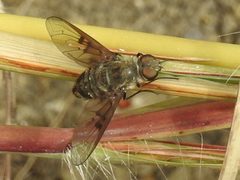
Anthrax larrea is a of bee fly in the Bombyliidae, described by Marston in 1963. It is recorded from the United States. As a member of the Anthrax, it likely shares the general of related species, which are of various insect larvae, though specific associations for this species remain undocumented.
Pronunciation
How to pronounce Anthrax larrea: /ˈænθræks læˈriːə/
These audio files are automatically generated. While they are not always 100% accurate, they are a good starting point.
Identification
Within the Anthrax, identification often relies on wing venation patterns, body coloration, and abdominal markings. The location of the r-m crossvein on the wing is a critical character distinguishing Anthrax from similar genera such as Systoechus. Without specific diagnostic features documented for A. larrea, precise identification requires comparison with or authoritative taxonomic keys.
Images
Distribution
United States
Similar Taxa
- Anthrax georgicusPreviously known as A. analis; the only Nearctic Anthrax with documented of tiger larvae (). A. larrea may be distinguished by geographic range and subtle morphological differences, though specific characters require taxonomic verification.
- Systoechus spp.Related bee flies in tribe Bombyliini; distinguished from Anthrax by the position of the r-m crossvein on the wing and typically later activity period (fall vs. spring for many Anthrax ).
More Details
Taxonomic Note
Authored by Norman B. Marston in 1963. The specific epithet 'larrea' appears to reference the Larrea (creosote bush), though whether this indicates an ecological association or is merely arbitrary remains unclear.
Data Deficiency
This is poorly represented in public databases, with only 22 observations recorded on iNaturalist as of the knowledge cutoff. No peer-reviewed studies specifically addressing its , associations, or have been identified.
Sources and further reading
- BugGuide
- Wikipedia
- GBIF taxonomy match
- iNaturalist taxon
- Catalogue of Life
- Bombyliidae | Beetles In The Bush | Page 2
- ID Challenge #11 | Beetles In The Bush
- Ground nesting bees beware of the bee fly: Bombyliidae — Bug of the Week
- Danger afoot for ground nesting bees: Look out for bee flies, Bombyliidae — Bug of the Week
- Bug Eric: The Stable Fly