
Anthrax albofasciatus
Macquart, 1840
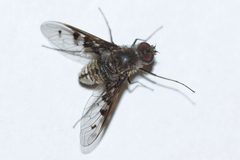
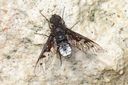
Anthrax albofasciatus is a of bee fly in the Bombyliidae, Anthracinae. The Anthrax comprises flies whose larvae attack stages of other insects, including tiger larvae and solitary larvae. are typically observed at flowers where they feed on nectar using an elongated . The species has a broad distribution across North America, Central America, and the Caribbean.
Pronunciation
How to pronounce Anthrax albofasciatus: /ˈæn.θræks ˌæl.boʊˌfæs.iˈeɪ.təs/
These audio files are automatically generated. While they are not always 100% accurate, they are a good starting point.
Identification
Members of the Anthrax can be distinguished from other Bombyliidae by wing venation characters, particularly the location of the r-m crossvein. -level identification within Anthrax requires examination of specific wing patterns, body coloration, and genitalic structures. Anthrax albofasciatus is characterized by distinctive white fasciae (bands) on the , as suggested by its specific epithet. may be confused with other bee flies in the tribe Anthracini, but the combination of abdominal banding pattern and geographic distribution helps distinguish this species.
Images
Distribution
Widespread across southern Canada, much of the United States, Mexico, Cuba, and Central America. Records include the Brazilian state of Roraima (BR-RR) and the U.S. state of Vermont.
Diet
feed on nectar from flowers. Larvae are that develop on stages of other insects.
Host Associations
- Tiger beetle larvae (Cicindelinae) - Based on documented relationships for other Anthrax ; specific host records for A. albofasciatus not confirmed in available sources.
- Solitary ground-nesting bees (Halictidae, Colletidae, Andrenidae) - Based on documented relationships for ; specific host records for A. albofasciatus not confirmed.
Life Cycle
Females deposit near or in burrows. Larvae attach externally to host larvae and feed as ectoparasitoids, eventually killing the host. Development includes egg, larval, pupal, and stages. Specific details for A. albofasciatus not documented; pattern inferred from .
Behavior
are agile fliers frequently observed hovering at flowers. Females exhibit -finding , tracking potential hosts to their burrows for oviposition.
Ecological Role
function as while feeding at flowers. Larvae act as , regulating of ground-nesting insects including tiger beetles and solitary bees.
Human Relevance
may be mistaken for bees due to their hairy appearance and flower-visiting , but they do not sting. The has no documented economic importance.
Similar Taxa
- Anthrax georgicusFormerly considered with A. analis; both parasitize tiger larvae. Distinguished by morphological details of wing venation and genitalia.
- Anthrax analisClosely related with similar ; distinguished by subtle differences in wing patterns and abdominal coloration.
- Bombylius species bee flies in the Bombylius share similar flower-visiting and general appearance, but differ in wing venation (position of r-m ) and seasonal activity patterns.
More Details
Taxonomic history
Authorship of this is sometimes cited as Macquart, 1834 or Macquart, 1840; Catalogue of Life accepts Macquart, 1840. The Anthrax has undergone taxonomic revision, with some former species now recognized as distinct or synonymized.
Research context
Most detailed biological studies of Anthrax have focused on A. analis/A. georgicus due to their impact on tiger . The of A. albofasciatus specifically remains poorly documented in the scientific literature.
Sources and further reading
- BugGuide
- Wikipedia
- GBIF taxonomy match
- iNaturalist taxon
- Catalogue of Life
- Bombyliidae | Beetles In The Bush | Page 2
- ID Challenge #11 | Beetles In The Bush
- Ground nesting bees beware of the bee fly: Bombyliidae — Bug of the Week
- Danger afoot for ground nesting bees: Look out for bee flies, Bombyliidae — Bug of the Week
- Bug Eric: The Stable Fly