
Stenopogoninae
robber flies
Genus Guides
33- Ablautus(Prospectors)
- Archilestris(robber fly)
- Backomyia
- Bohartia
- Callinicus
- Ceraturgus(Tiger Flies)
- Coleomyia
- Cyrtopogon(robber fly)
- Dicolonus
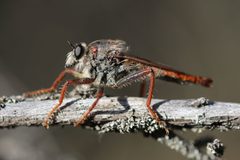
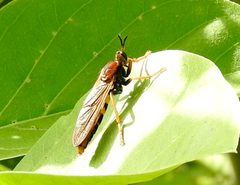
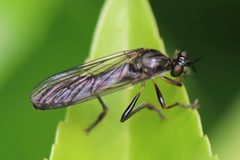
Stenopogoninae is a of robber flies (Asilidae) containing more than 70 and approximately 740 described . Members are predatory dipterans found across diverse worldwide. The subfamily includes notably small species such as those in the genus Eudioctria (6–8 mm), as well as larger forms. Many species exhibit characteristic perching on vegetation and are active of other insects.
Pronunciation
How to pronounce Stenopogoninae: //ˌstɛnoʊˈpɒɡənaɪ//
These audio files are automatically generated. While they are not always 100% accurate, they are a good starting point.
Identification
Members of Stenopogoninae can be distinguished from other Asilidae by combinations of morphological features including facial structure, mystax composition, and genitalia characteristics. Some exhibit distinctive traits: Eudioctria superficially resemble Cerotainia (Laphriinae) but lack the extra-long ; Wilcoxia species show structural heterogeneity with two defined species groups based on morphological features. Species-level identification typically requires examination of facial gibbosities, pollinosity patterns, and male genitalia.
Images
Habitat
vary by and . Eudioctria species prefer flat leaves at the top of small shrubs. Wilcoxia species are distributed primarily in southwestern United States and associated with arid and semi-arid environments. Heteropogon species frequent forest edges where they perch on twig tips at level. Empodiodes species are to Southern Africa.
Distribution
Worldwide distribution with strong representation in North America, South America, Southern Africa, and arid regions of the southwestern United States and Mexico. Specific show restricted ranges: Empodiodes is Southern African ; Wilcoxia is primarily southwestern United States and Mexico; Eudioctria is primarily western North America with four extending to eastern states.
Diet
Predatory. Documented prey records for Wilcoxia include Hemiptera (eight ), Coleoptera (one family), Hymenoptera (five families), and Diptera (10 families). Prey capture involves used to penetrate weak points in such as neck , abdominal segment junctions, or thoracic seams.
Behavior
Perching varies among : Eudioctria prefers flat leaves at the top of small shrubs; Cerotainia (similar-looking but unrelated) tends to perch on twig-ends. Heteropogon habitually perch on twig tips at forest edges, surveying for prey and cocking their to track passing insects. Courtship behavior in Heteropogon involves males hovering before females with hind legs spread to display coloration, stroking female with ornamented fore while hovering. Some species engage in behavior, with males perching at high points to defend territories and locate females.
Ecological Role
Aerial that contribute to regulation of insect . Prey records indicate broad dietary breadth across multiple insect orders, suggesting significant predatory impact on diverse in their respective .
Similar Taxa
- LaphriinaeBoth contain robber flies with similar predatory habits. Eudioctria (Stenopogoninae) superficially resembles Cerotainia (Laphriinae) but lacks the extra-long characteristic of Laphriinae and shows different perching preferences.
- DasypogoninaeBoth are robber fly with predatory . Distinguishable by morphological features of the mystax, facial structure, and genitalia.
Sources and further reading
- BugGuide
- Wikipedia
- iNaturalist taxon
- NCBI Taxonomy
- Catalogue of Life
- Bug Eric: Robber Fly: Heteropogon macerinus
- Asilidae | Beetles In The Bush | Page 2
- Review of the Nearctic genus Wilcoxia James (Diptera: Asilidae: Stenopogoninae), with descriptions of three new species
- A revision of Empodiodes Oldroyd, 1972 with the descriptions of two new species from South Africa (Diptera, Asilidae, Stenopogoninae)