
Cyrtopogon
Loew, 1847
robber fly
Species Guides
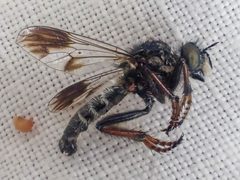
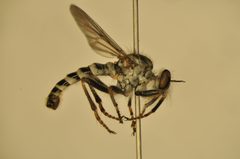
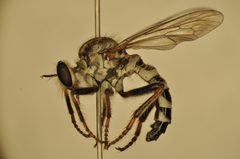
68Cyrtopogon is a of robber flies in the Asilidae, comprising at least 120 described . These predatory flies are opportunistic hunters of small insects, with documented prey spanning 25 families across 7 orders. Males of at least some species perform elaborate involving visual signals and specialized structures. The genus exhibits thermoregulatory including lateral and basking, and appears dependent on direct sunlight for sustained .
Pronunciation
How to pronounce Cyrtopogon: //sɪrˈtɒpəɡɒn//
These audio files are automatically generated. While they are not always 100% accurate, they are a good starting point.
Images
Diet
Opportunistic of relatively small insects. Documented prey in Cyrtopogon willistoni includes Diptera (44%), (21%), with Cicadellidae, Bibionidae, and Formicidae comprising 44% of prey items.
Behavior
Males perform elaborate courtship including audible airborne visual displays utilizing silvery-white combs of hairs on the foretarsi. While perching, flies exhibit lateral and basking postures. Strong capability appears limited to periods of direct sunlight availability.
Ecological Role
of small insects in terrestrial .
Sources and further reading
- BugGuide
- Wikipedia
- iNaturalist taxon
- NCBI Taxonomy
- Catalogue of Life
- Bug Eric: The Bigger Picture
- Bug Eric: Blodgett Peak Bioblitz Report
- Where have all the honeybees gone? Honeybees, Apis mellifera — Bug of the Week
- Foraging, Mating, and Thermoregulatory Behavior of Cyrtopogon willistoni Curran (Diptera: Asilidae)
- Distribution géographique de quelques tabanidae dans le Sud Est de la France. Localité nouvelle de Cyrtopogon meyerduri (Diptères orthoraphes).