
Ablautus
Loew, 1866
Prospectors
Species Guides
13- Ablautus arnaudi
- Ablautus basini(Great Basin Prospector)
- Ablautus californicus
- Ablautus coachellus(Coachella Prospector)
- Ablautus colei(Northwestern Prospector)
- Ablautus coquilletti(Coquillett Prospector)
- Ablautus flavipes(Yellow-legged Prospector)
- Ablautus linsleyi(Linsley Prospector)
- Ablautus mimus(Arizona Prospector)
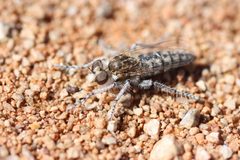
Ablautus is a of small robber flies ( Asilidae) containing approximately 14 described . measure 6–7 millimeters and inhabit arid regions of western and southwestern North America, particularly sandy areas within sagebrush . The genus exhibits notable mimicry relationships, with Ablautus mimus known to mimic Lestomyia sabulonum. Species were described primarily by J. Wilcox during 1935–1966, with the genus first established by Loew in 1866.
Pronunciation
How to pronounce Ablautus: /əˈblaʊtəs/
These audio files are automatically generated. While they are not always 100% accurate, they are a good starting point.
Identification
Distinguished from other small Asilidae by combination of tiny size (6–7 mm), sand-colored body, and specific facial hair coloration dimorphism. Males identifiable by bright white facial setation versus gold/ochre in females. May be confused with Lestomyia sabulonum due to mimicry relationship in Ablautus mimus; separation requires examination of wing venation and other structural characters. From Cyrtopogon ablautoides (which resembles Ablautus mimus) by specific morphological details requiring examination.
Images
Habitat
Arid and semi-arid regions of western North America, specifically sandy localities within sagebrush . Strong association with sandy substrates. Open, dry environments with sparse vegetation.
Distribution
Western and southwestern North America, including arid regions of the United States (particularly California, Colorado, and adjacent states). distributions within the vary; some have restricted ranges.
Seasonality
active in early spring. Peak activity coincides with warming temperatures in arid western .
Behavior
Predatory on insects smaller than themselves; one observation records on leafhoppers (Cicadellidae). Males exhibit elaborate : approaching stationary females, alighting nearby, flying and repositioning, eventually waving front legs while rocking up and down. Males highly persistent once courting begins, not easily disturbed. Courtship involves aerial and ground-based components.
Similar Taxa
- Lestomyia sabulonumAblautus mimus exhibits mimicry of this ; both share sandy associations and similar appearance, requiring careful examination to distinguish
- Cyrtopogon ablautoidesSuperficial resemblance to Ablautus mimus in sandy desert regions; structural characters separate the
More Details
Taxonomic history
established by Hermann Loew in 1866 with Ablautus trifarius as type . Majority of species (9 of 14) described by J. Wilcox between 1935 and 1966. Current revisionary work being conducted by Charlotte Herbert Alberts (UC Davis) as of 2019.
Mimicry associations
Ablautus mimus is documented mimicking Lestomyia sabulonum, with which it shares sandy soil . This represents a rare example of intergeneric mimicry within Asilidae. The selective advantage of this mimicry remains unstudied.