
Marava arachidis
(Yersin, 1860)
Bone-house Earwig
Marava arachidis is a in the Spongiphoridae with probable Indo-Australian origin. It exhibits , with females retaining embryos in thin envelopes until shortly before hatching. The species has demonstrated predatory capability on eggs and larvae in laboratory conditions, suggesting potential as a agent. It is frequently associated with stored organic materials and fennel plants.
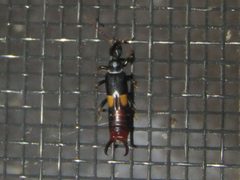
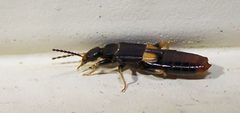
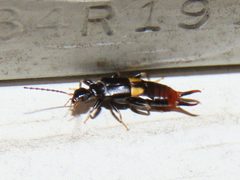
Identification
Identified through morphological examination and molecular (COI gene), with approximately 1.55% sequence divergence from reference specimens. As a member of Spongiphoridae, it lacks the prominent forceps of some other , though specific diagnostic features for field identification are not documented in available sources.
Images
Habitat
Found in stored animal rations, bakeries, bran, and water houses of imported organic materials. Uses fennel plants (Foeniculum vulgare) for shelter and climbs stems to feed on nectar. Occurs in tropical regions and has established in temperate areas through human-mediated transport.
Distribution
distribution with established in Africa, Australia, the Caribbean, Europe, Northern Asia (excluding China), North America, South America, and Southern Asia. First recorded in Egypt from Beni-Suef. Present in California since 1920. Sporadic occurrences in Britain and northern Europe.
Diet
Feeds on aphids and fennel nectar. Laboratory studies demonstrate consumption of and larvae (Rhipicephalus annulatus), with mean of 18.64 ± 11.18 eggs and 12.32 ± 9.07 larvae per 24 hours at 1:10 -prey ratio.
Host Associations
- Foeniculum vulgare - shelter and nectar sourcefemales lay on leaves; used as climbing structure
- Rhipicephalus annulatus - and larvae consumed in laboratory conditions
- Aphidoidea - aphids reported as prey based on literature citation, not direct observation
Life Cycle
: females retain well-developed embryos encased in thin but complete envelopes until a few minutes before hatching. Laboratory rearing is reportedly easy with available artificial diets.
Behavior
Exhibits -dependent on and larvae, with consumption rates increasing linearly with density. Climbs vegetation to access nectar sources. Predation includes breaking eggs and killing larvae beyond immediate consumption.
Ecological Role
Potential agent for , particularly Rhipipicephalus annulatus. Functions as a in laboratory settings, though field efficacy remains unverified.
Human Relevance
Recorded as a pest or inhabitant of stored food facilities including bakeries and animal ration storage. Investigated for applications against cattle ticks. Easily reared in laboratory conditions for research purposes.
Similar Taxa
- Marava spp.congeneric share general and preferences; requires molecular or detailed morphological examination for differentiation
- Other Spongiphoridae members lack the prominent forceps characteristic of Forficulidae; identification to level requires expert examination
More Details
Laboratory predation limitations
Experimental results used undefined mixes of without distinguishing sex or age effects. Field efficacy as a agent has not been demonstrated.
Taxonomic identification
Egyptian identified using both and COI with 1.55% divergence from Malaysian reference sequence.