
Lasconotus
Erichson, 1845
cylindrical bark beetles
Species Guides
12- Lasconotus borealis(Boreal Ironclad Beetle)
- Lasconotus fitzgibbonae
- Lasconotus intricatus(Intricate Ironclad Beetle)
- Lasconotus laqueatus
- Lasconotus linearis
- Lasconotus nucleatus
- Lasconotus pusillus
- Lasconotus referendarius
- Lasconotus servus
Lasconotus is a of cylindrical bark beetles in the Zopheridae, established by Erichson in 1845. The genus contains at least 20 described . Members are associated with coniferous forests, particularly spruce systems. Some species exhibit specialized behavioral adaptations, including attraction to bark beetle .
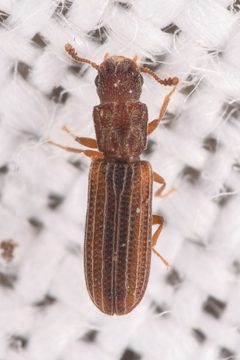
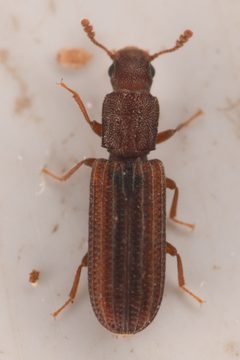
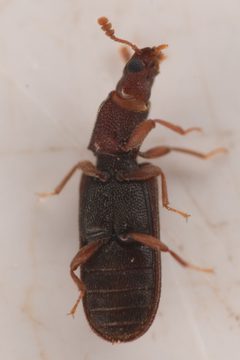
Pronunciation
How to pronounce Lasconotus: /læskoʊˈnoʊtəs/
These audio files are automatically generated. While they are not always 100% accurate, they are a good starting point.
Images
Habitat
Associated with coniferous forests, particularly spruce (Picea) systems. Lasconotus intricatus has been documented in association with black spruce (Picea mariana) infested by the four-eyed spruce bark beetle, Polygraphus rufipennis.
Distribution
Distribution records exist from Norway (NO) and Sweden (SE) based on GBIF data. -specific distributions are poorly documented; L. intricatus is associated with North American spruce forests.
Seasonality
Lasconotus intricatus shows activity in spring and summer, with high temporal synchronism to the four-eyed spruce bark beetle Polygraphus rufipennis.
Host Associations
- Picea mariana - associationblack spruce; tree for associated bark beetles
- Polygraphus rufipennis - ecological associationfour-eyed spruce bark beetle; Lasconotus intricatus attracted to its
Behavior
Lasconotus intricatus is attracted to the male-produced 3-methyl-3-buten-1-ol of Polygraphus rufipennis. This attraction is reduced by terpenes bornyl acetate and β-pinene, and partially inhibited by 3-carene, myrcene, and α-pinene. The is hypothesized to use this pheromone as a host-finding .
Ecological Role
Likely or in bark beetle gallery systems in coniferous trees. Lasconotus intricatus appears to track bark beetle through chemical cues, suggesting a predatory or commensal relationship with scolytine beetles.
Sources and further reading
- BugGuide
- Wikipedia
- GBIF taxonomy match
- iNaturalist taxon
- NCBI Taxonomy
- Biology of Lasconotus subcostulatus (Coleoptera: Colydiidae) with Special Reference to Feeding Behavior
- ATTRACTION OF LASCONOTUS INTRICATUS KRAUS. (COLEOPTERA: COLYDIIDAE) TO THE AGGREGATION PHEROMONE OF THE FOUR-EYED SPRUCE BARK BEETLE, POLYGRAPHUS RUFIPENNIS (KIRBY) (COLEOPTERA: SCOLYTIDAE)