
Meracantha contracta
Palisot de Beauvois, 1812
Contracted Darkling Beetle
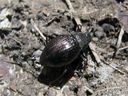
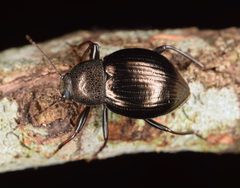
Meracantha contracta is a North American darkling beetle (Tenebrionidae) distinguished by its strongly convex, humped body profile and association with decaying wood. measure 11-14 mm and are bronze-black when mature. The overwinters as larvae within rotting logs, producing antifreeze compounds to survive temperatures down to approximately -11°C. It has been recorded from at least Ontario, Canada, with broader distribution across North America.
Pronunciation
How to pronounce Meracantha contracta: /ˈmɛrəˌkænθə kənˈtræk.tə/
These audio files are automatically generated. While they are not always 100% accurate, they are a good starting point.
Identification
: Distinguished from similar darkling beetles by the combination of large pronotum, strongly convex (humped) and , and uniform bronze-black coloration in mature specimens. The punctate surface texture and body shape are distinctive. Larvae: The obliquely , concave ninth abdominal segment with acute margins is diagnostic and unique among North American Tenebrionidae.
Images
Habitat
Occurs under bark and on dead tree stumps, particularly those supporting lichen and moss growth. Larvae overwinter inside rotting logs.
Distribution
North America. Documented from Ontario, Canada (ISO 3166-2:CA-ON). Wider distribution implied by 'North American' designation but specific range boundaries require further documentation.
Seasonality
Overwinters in larval stage. occurs in spring with pupal stage lasting 10-14 days. live for a few months. Activity period not fully documented but adults presumably active during warmer months following spring .
Diet
One source reports feeding on arboreal lichens; another describes bark-eating habits. Larvae have been reared in captivity on chick feed supplemented with leaf litter. Natural diet requires further clarification.
Life Cycle
Complete : , larva, pupa, . Overwinters as larva inside rotting logs. Produces macromolecular antifreeze (similar to cold-water fishes) enabling survival to approximately -11°C. Pupal stage 10-14 days. Adult lifespan a few months.
Behavior
Larval includes production of antifreeze compounds for cold . No other specific behaviors documented.
Ecological Role
Associated with decaying wood and lichen . Serves as for flies: pupae parasitized by bombyllid fly Villa alternata (=Anthrax alternata); larvae parasitized by tachinid flies of Pales (=Neopales).
Human Relevance
No documented economic or medical significance. Occasionally reared in captivity.
Similar Taxa
- Other Meracantha speciesShare -level traits; M. contracta distinguished by specific body proportions and larval abdominal segment .
- Other Tenebrionidae with convex bodiesM. contracta separated by combination of punctate pronotum and , humped profile, and large pronotum relative to body.
More Details
Antifreeze biochemistry
Larvae produce macromolecular antifreeze functionally similar to that of cold-water fishes, an unusual convergent in a terrestrial insect for subzero survival in rotting logs.
Parasitoid associations
Documented for two fly lineages: bombyllid Villa alternata (pupal parasitoid) and tachinid Pales/Neopales (larval parasitoid).