
Stenomorpha opaca
(Say, 1824)
Stenomorpha opaca is a darkling beetle (Tenebrionidae) native to North America. The is moderately well-documented through observational records, with over 700 observations on iNaturalist. As a member of a large and diverse of beetles, it occupies arid and semi-arid . Specific ecological details remain limited in published literature.
Pronunciation
How to pronounce Stenomorpha opaca: /ˌstɛnəˈmɔrfə oʊˈpɑkə/
These audio files are automatically generated. While they are not always 100% accurate, they are a good starting point.
Identification
Distinguished from similar darkling beetles by the combination of dull, non-lustrous (the namesake 'opaca' or opaque quality), without clubbed tips, and the elongate-oval body form. Separation from congeneric requires examination of subtle morphological details including antennal segment proportions, pronotal shape, and elytral striation patterns. Precise identification may require reference to specialized keys for North American Tenebrionidae.
Images
Appearance
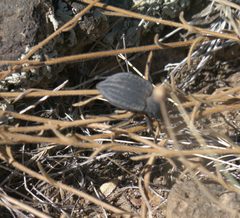
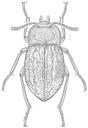
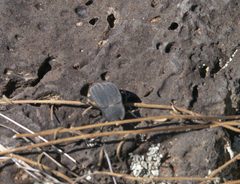
are elongate-oval beetles with a dull, matte (opaca) surface finish. The body is generally dark brown to black. are (thread-like) and moderately long. are along the midline and completely cover the . The overall body form is somewhat flattened dorsoventrally.
Habitat
Arid and semi-arid environments including desert scrub, grasslands, and open dry woodlands. Associated with sandy or rocky substrates. Often found under debris, stones, or within soil surface litter.
Distribution
North America, with records primarily from the southwestern United States and adjacent regions of Mexico. Distribution corresponds broadly to arid and semi-arid zones of the continent.
Seasonality
activity has been recorded across multiple months, with peak observations during warmer seasons. Specific phenological patterns are not well-documented.
Behavior
are ground-dwelling and , seeking shelter under surface objects during daylight hours. Exhibits typical cryptic of desert tenebrionids, remaining inactive in sheltered microhabitats to avoid desiccation.
Ecological Role
Contributes to decomposition processes as a in arid . Serves as prey for various vertebrate and .
Human Relevance
No documented economic or medical significance. Occasionally encountered by entomologists and naturalists in field surveys.
Similar Taxa
- Other Stenomorpha speciesCongeneric share general body plan and require detailed morphological examination for separation; S. opaca distinguished by dull elytral surface and specific antennal proportions
- Eusattus and related tenebrionine generaSimilar preferences and body form; differ in antennal structure, pronotal margins, and often exhibit more convex body profiles
More Details
Taxonomic history
Originally described by Thomas Say in 1824, this has remained within the Stenomorpha throughout its taxonomic history. The genus is part of the speciose tribe Tenebrionini within Tenebrionidae.