
Myrmechixenini
Jacquelin du Val, 1858
Genus Guides
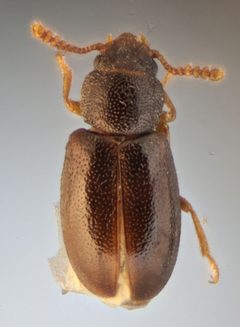
1Myrmechixenini is a tribe of darkling beetles ( Tenebrionidae) established by Jacquelin du Val in 1858. The tribe belongs to the Diaperinae within the speciose family Tenebrionidae, one of the largest families of beetles. Members of this tribe are characterized by their association with colonies, reflecting the etymology of the name (from Greek myrmex, ant, and xenia, hospitality). The tribe contains relatively few described and is poorly represented in collections, with only 13 observations recorded on iNaturalist.
Pronunciation
How to pronounce Myrmechixenini: //mərˌmɛk.sɪˈksɛn.ɪˌnaɪ//
These audio files are automatically generated. While they are not always 100% accurate, they are a good starting point.
Identification
Myrmechixenini can be distinguished from other Diaperinae tribes by morphological adaptations associated with myrmecophily. The tribe is characterized by compact body forms, often with reduced or modified patterns, and that may be clubbed or otherwise modified for life within nests. Exact diagnostic characters require examination of genitalic and other internal structures; external alone may not reliably separate Myrmechixenini from related myrmecophilous tribes without specialized knowledge.
Images
Habitat
in this tribe are obligate or facultative myrmecophiles, inhabiting nests of ants (Formicidae). They occupy the protected microenvironment of colonies, typically in soil, rotting wood, or other substrates where ants establish nests. The specific microhabitat within nests varies by species and may include chambers near , refuse piles, or peripheral nest areas.
Distribution
The tribe has been recorded from the Palearctic region, with particular concentration in Europe and Mediterranean areas. Distribution records are sparse due to the cryptic nature of these beetles and the difficulty of sampling within colonies. Specific range limits for the tribe as a whole remain poorly documented.
Host Associations
- Formicidae - myrmecophileobligate or facultative in nests; specific associations vary by and
Behavior
and larvae of Myrmechixenini live within colonies, where they have evolved behavioral and chemical mechanisms to integrate with societies. These beetles are thought to employ chemical mimicry or camouflage to avoid detection and aggression by host ants. The degree of integration varies; some may be tolerated guests while others are more deeply integrated into colony life.
Ecological Role
As myrmecophiles, members of this tribe represent a specialized component of the within colonies. Their ecological functions within nests are not well documented but likely include decomposition of organic matter and participation in the complex community dynamics of ant-associated fauna. They contribute to the documented diversity of the Tenebrionidae as one of several lineages that have independently evolved myrmecophily.
Human Relevance
Myrmechixenini has no direct economic importance. The tribe is of interest to myrmecologists and coleopterists studying the evolution of myrmecophily and - or host-commensal relationships. The cryptic habits and rarity in collections make these beetles subjects of specialized systematic research rather than general entomological interest.
Similar Taxa
- Cossyphodinianother tribe of Diaperinae containing myrmecophilous ; distinguished by different antennal and tarsal
- Diaperinithe nominotypical tribe of Diaperinae; most members are free-living rather than myrmecophilous, with different body proportions and associations
More Details
Taxonomic History
The tribe was established by Pierre Nicolas Camille Jacquelin du Val in 1858. The classification of myrmecophilous Tenebrionidae has undergone repeated revision, and the limits of Myrmechixenini have been adjusted as myrmecophily has been recognized as a convergent trait in multiple lineages.
Research Challenges
Study of Myrmechixenini is hampered by the difficulty of collecting specimens from nests and the scarcity of material in museum collections. Many are known from very few specimens, and biological data are correspondingly limited.