
Trogloderus
LeConte, 1879
Species Guides
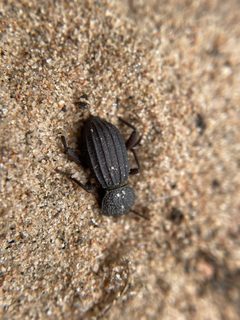
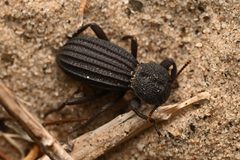
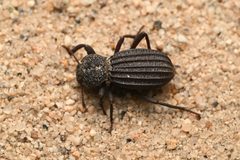
10Trogloderus is a of psammophilic darkling beetles (Coleoptera: Tenebrionidae) to dunes and sandy in the western United States. The genus comprises ten described , including six new species described in 2019 from desert regions across the Intermountain Region. Molecular phylogenetic analysis dates the most recent common ancestor to 5.2 million years ago, with speciation driven by geographic features of the Lahontan Trough, Bouse Embayment, and Kaibab Plateau during the mid-Pleistocene.
Pronunciation
How to pronounce Trogloderus: /ˌtroʊɡloʊˈdɛrəs/
These audio files are automatically generated. While they are not always 100% accurate, they are a good starting point.
Images
Habitat
Strictly psammophilic; restricted to dunes and sandy in arid regions. Occupies desert sand dune systems including active and stabilized dunes, sandy flats, and sandy washes within pinyon-juniper woodland, shortgrass prairie, and desert scrub .
Distribution
to the Intermountain Region of western North America, encompassing arid lands between the Rocky Mountains and Sierra Nevada. Ranges across the Great Basin and Mojave Desert to the west and the Colorado Plateau to the east. Specific biogeographic regions include: Lahontan Trough (T. arcanus), Owens Valley (T. kandai), Mohave Desert (T. major), eastern Great Basin and Mohave Desert (T. skillmani), eastern Colorado Plateau (T. verpus), and western Colorado Plateau (T. warneri). Also includes T. costatus, T. tuberculatus, T. nevadus, and T. vandykei.
Behavior
Nocturnally active; has been observed attracted to incandescent building lights at night.
Sources and further reading
- BugGuide
- Wikipedia
- GBIF taxonomy match
- iNaturalist taxon
- NCBI Taxonomy
- Catalogue of Life
- Eumastacidae | Beetles In The Bush
- Phylogenetic revision of the psammophilic Trogloderus LeConte (Coleoptera: Tenebrionidae), with biogeographic implications for the Intermountain Region
- Figure 8: Distribution map, Trogloderus arcanus Johnston n.sp., T. costatus LeConte, T. kandai Johnston n.sp.
- Figure 10: Distribution map, Trogloderus tuberculatus Blaisdell, T. vandykei La Rivers, T. verpus Johnston n.sp., T. warneri Johnston n.sp.
- Figure 9: Distribution map, Trogloderus major Johnston n.sp., T. nevadus La Rivers, T. skillmani Johnston n.sp.