
Eleodes caudifera
LeConte, 1858
desert stink beetle
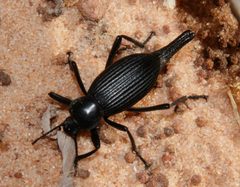
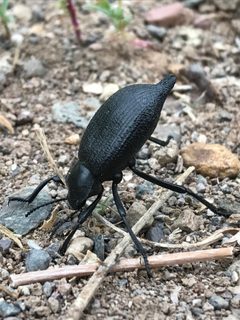
Eleodes caudifera is a of darkling beetle in the Tenebrionidae, commonly referred to as a desert stink beetle. The species is native to arid regions of western North America and exhibits the defensive -standing typical of the Eleodes. It has been documented in sandy desert , particularly in association with dune systems. The species was described by LeConte in 1858.
Pronunciation
How to pronounce Eleodes caudifera: /ˈɛliˌoʊdiːz kɔːˈdɪfərə/
These audio files are automatically generated. While they are not always 100% accurate, they are a good starting point.
Identification
Eleodes caudifera can be distinguished from other Eleodes by examination of specific morphological characters, including details of the elytral surface and body proportions. Accurate identification to species level within Eleodes typically requires examination of genitalic structures or other subtle morphological features. The species is part of a large where superficially similar species are common, making precise identification challenging without detailed examination.
Images
Habitat
Sandy desert environments, particularly sand dune systems. The has been observed in active dune fields and adjacent sandy areas with sparse vegetation.
Distribution
Documented from the southwestern United States, specifically recorded from Utah (Coral Pink Sand Dunes area) and likely occurs more broadly in the arid regions of the western United States and adjacent Mexico. GBIF records indicate presence in Mexico (MX).
Seasonality
have been observed in early June, suggesting spring to early summer activity. The likely exhibits activity patterns tied to temperature and moisture conditions typical of desert environments.
Behavior
Exhibits the characteristic defensive of Eleodes : when disturbed, the raises its and stands on its , presenting its defensive glands toward the threat. This posture, combined with the emission of noxious chemical secretions, deters . The species has been observed moving slowly across open sand surfaces, a gait described as lumbering.
Ecological Role
Functions as a in desert , contributing to nutrient cycling through consumption of decaying plant material. Serves as prey for various desert including birds, reptiles, and mammals. The defensive chemical secretions represent an important chemical defense strategy within desert .
Human Relevance
Like other Eleodes , may be kept as a low-maintenance pet due to hardiness and longevity in captivity. The defensive secretions can be irritating if handled carelessly. Of minor interest to entomologists studying desert beetle and chemical defense evolution.
Similar Taxa
- Eleodes suturalisBoth are large Eleodes with dark coloration and similar body form; E. suturalis is distinguished by sutural coloration and specific elytral sculpturing
- Other Eleodes speciesNumerous share the -standing defensive and general darkling beetle ; precise identification requires examination of specific structural characters
More Details
Etymology
The specific epithet 'caudifera' likely refers to the tail-bearing or structure, possibly alluding to the elevated during defensive posturing.
Field observation notes
In June 2025, specimens were observed at Coral Pink Sand Dunes in southern Utah, where individuals were seen lumbering across open sand surfaces during late afternoon hours.