
Ripiphorus luteipennis
(LeConte, 1865)
Ripiphorus luteipennis is a of wedge-shaped beetle in the Ripiphoridae. The species was described by LeConte in 1865. Like other members of its , it exhibits , a complex involving multiple larval forms. It is known from North America, with records from Québec, Canada.
Pronunciation
How to pronounce Ripiphorus luteipennis: /rɪˈpɪfɔːrəs ˌluːteɪˈpɛnɪs/
These audio files are automatically generated. While they are not always 100% accurate, they are a good starting point.
Identification
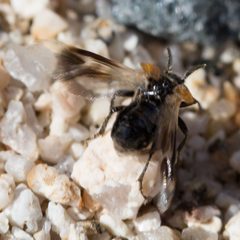
Shortened exposing abdominal segments distinguishes Ripiphoridae from most other . Within Ripiphorus, R. luteipennis is distinguished by the yellowish coloration of the elytra; often have darker or patterned elytra. The combination of pale elytra and North American distribution separates it from similar . Final identification may require examination of male genitalia.
Images
Habitat
Associated with deciduous forests and woodland edges. Larvae develop as in the nests of bees, particularly Andrenidae. are found on flowers and vegetation in sunny openings within forested landscapes.
Distribution
North America. Documented from Québec, Canada, with broader distribution across eastern and central North America inferred from -level patterns.
Seasonality
active from late spring through summer, with peak activity in June and July. Larval stages present year-round within nests.
Host Associations
- Andrenidae - Larvae are of ground-nesting bees in Andrenidae; specific for R. luteipennis not confirmed
Life Cycle
Hypermetamorphic. First instar larvae (triungulins) are active and seek out nests. Subsequent instars are -like and feed within host , consuming host provisions and often the host or larva. occurs in the host nest. are short-lived and do not feed.
Behavior
are and visit flowers. Triungulin larvae exhibit phoretic , attaching to bees to be transported to nests. Adults are weak fliers and often found resting on vegetation.
Ecological Role
of ground-nesting bees, potentially regulating . flower visitation may contribute to pollination, though this has not been quantified.
Human Relevance
No direct economic importance. Occasionally encountered by researchers and entomologists. Not a pest of managed honey bees.
Similar Taxa
- Ripiphorus fasciatusOverlapping distribution; distinguished by darker, often fasciate (banded) rather than uniformly pale yellow
- Ripiphorus subdipressusSimilar size and form; more depressed and often darker; requires examination of male genitalia for definitive separation
- Macrosiagon spp.Same but different ; more elongate body form, different antennal structure, and different associations (Vespidae)
More Details
Taxonomic history
Originally described in the Myodites by LeConte in 1865; later transferred to Ripiphorus. The Ripiphoridae has been variously treated as Ripiphoridae or in literature; Ripiphoridae is now preferred.
Conservation status
Not assessed by IUCN. Vulnerable to loss affecting and to exposure in agricultural landscapes.