
Ripiphorus fasciatus
(Say, 1824)
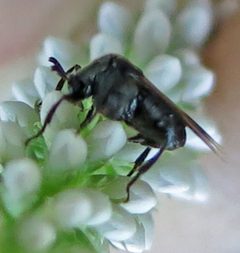
Ripiphorus fasciatus is a of wedge-shaped beetle in the Ripiphoridae. The larvae are , likely targeting ground-nesting Halictid bees. have a distinctive appearance with and clear hindwings, superficially resembling bees or flies. This species has been documented in northeastern North America.
Pronunciation
How to pronounce Ripiphorus fasciatus: //ˌrɪpɪˈfoʊrəs fæˈsiːeɪtəs//
These audio files are automatically generated. While they are not always 100% accurate, they are a good starting point.
Identification
Distinguished from similar beetles by the combination of wedge-shaped body, , and clear hindwings. The -like or fly-like superficial appearance may cause confusion with Hymenoptera or Diptera, but the 's hardened forewings () and other coleopteran features confirm its identity. Separation from other Ripiphorus requires detailed examination.
Images
Habitat
Associated with supporting ground-nesting bees, particularly Halictid bees. Specific microhabitat preferences for are not well documented.
Distribution
Documented in the northeastern United States and Eastern Canada. GBIF records confirm presence in Alberta, New Brunswick, and Nova Scotia in Canada.
Host Associations
- Halictid bees - probable larval Likely parasitizes ground-nesting Halictid bees; inferred from -level and specific association noted in sources
Life Cycle
Larvae are , developing within nests. Specific details of -laying , larval instars, and for this are not documented.
Ecological Role
As a of ground-nesting bees, likely functions as a regulator of . Contributes to the complex of organisms associated with bee nests.
Similar Taxa
- Other Ripiphorus speciesShare wedge-shaped body, lifestyle, and general appearance; require detailed morphological examination for separation
- Bees (Hymenoptera: Apoidea)Superficial resemblance due to body shape and appearance; distinguished by , structure, and other coleopteran features
- Flies (Diptera)Superficial resemblance in and general form; distinguished by single pair of wings in true flies versus two pairs (with covering hindwings) in beetles
More Details
Taxonomic note
The Ripiphorus (formerly placed in , now Ripiphoridae) contains with highly modified involving of bees and .
Sources and further reading
- BugGuide
- Wikipedia
- GBIF taxonomy match
- iNaturalist taxon
- NCBI Taxonomy
- What do insects do in winter? Migrants in the DMV: Common Buckeye, Junonia coenia, Variegated Fritillary, Euptoieta Claudia, Painted Lady, Vanessa cardui, Large Milkweed bug, Oncopeltus fasciatus — Bug of the Week
- Bugs in Orange and Black II: Large milkweed bug, Oncopeltus fasciatus — Bug of the Week
- Orange and Black II: Milkweed leaf beetle, Labidomera clivicollis; Oleander aphid, Aphis nerii; Milkweed Bug, Oncopeltus fasciatus; Monarch, Danaus plexippus — Bug of the Week
- Bugs in orange and black - Monarch butterfly, Danaus plexippus Milkweed Bug - Oncopeltus fasciatus; Milkweed tiger moth, Euchaetes egle — Bug of the Week
- Orange and Black Bugs- Milkweed leaf beetle, Labidomera clivicollis; Oleander aphid, Aphis nerii; Milkweed Bug - Oncopeltus fasciatus; Monarch butterfly, Danaus plexippus — Bug of the Week
- Bugs in orange and black: A spooky Halloween trick or treat for predators - Small and large milkweed bugs, 'Lygaeus kalmii' and 'Oncopeltus fasciatus' — Bug of the Week