
Macrosiagon cruenta
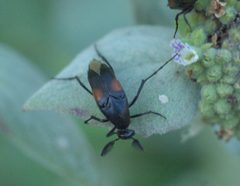
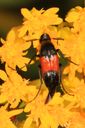
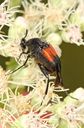
Macrosiagon cruenta is a wedge-shaped beetle in the Ripiphoridae. The is known to occur as a nest or of mason wasp larvae, specifically in nests of Ancistrocerus campestris. Larvae have been observed preying on larvae within pre-existing borings in wood, hollowed twigs, or abandoned mud dauber nests. The species has been documented across eastern and central North America.
Pronunciation
How to pronounce Macrosiagon cruenta: //ˌmækroʊsiˈæɡɒn kɹuˈɛntə//
These audio files are automatically generated. While they are not always 100% accurate, they are a good starting point.
Images
Habitat
Associated with woodland edges and forest where mason wasps occur. Found in proximity to nest sites including pre-existing borings in wood, hollowed-out sumac twigs, and abandoned mud dauber nests.
Distribution
Eastern and central North America, ranging from southern Ontario, Canada through New England south to Florida, and west to Minnesota, South Dakota, Kansas, and Texas. Distribution corresponds to that of its known , Ancistrocerus campestris.
Diet
Larval stage has been observed preying on larvae of the mason wasp Ancistrocerus campestris. Specific feeding habits are not documented.
Host Associations
- Ancistrocerus campestris - / of larvae prey on larvae in nests
Life Cycle
Larvae are -like and develop within the nest of mason wasps, consuming the larvae provisioned there. Complete developmental details including -laying and site are not documented.
Behavior
Larvae invade nests of mason wasps to prey on larvae. Specific including , mating, or patterns are not documented.
Ecological Role
Acts as a nest or within the guild of cavity-nesting Hymenoptera, potentially regulating of mason wasps.
Similar Taxa
- Macrosiagon cruentumClosely related with similar ; the two names have been used interchangeably in some literature (e.g., Krombein 1967 records 'Macrosiagon cruentum' as a of mason wasps, while iNaturalist and modern sources use M. cruenta). Specific morphological distinctions between these require verification.
More Details
Taxonomic Note
The name appears in literature as both 'Macrosiagon cruenta' and 'Macrosiagon cruentum'. The iNaturalist database uses M. cruenta, while Krombein's 1967 work on trap-nesting records 'M. cruentum' as parasitizing nests of Ancistrocerus antilope and other wasps. The relationship between these names requires taxonomic verification.