
Rhinoplatia ruficollis
Horn, 1868
red-necked false blister beetle
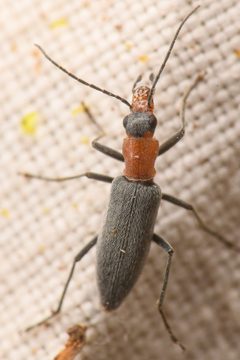
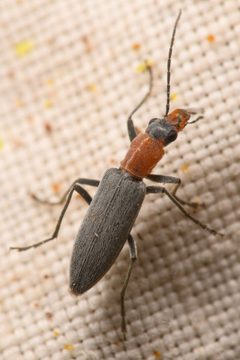
Rhinoplatia ruficollis is a of false blister beetle in the Oedemeridae, characterized by a reddish-orange pronotum contrasting with black . It occurs in North America and has been documented visiting flowers of Prunus mexicana (Mexican plum) and Amelanchier arborea (downy serviceberry) in early spring. The species is among the more frequently encountered oedemerids in its range.
Pronunciation
How to pronounce Rhinoplatia ruficollis: /ˌraɪnoʊˈpleɪʃə ˌruːfɪˈkɒlɪs/
These audio files are automatically generated. While they are not always 100% accurate, they are a good starting point.
Identification
The combination of reddish-orange pronotum with black distinguishes this from most other North American Oedemeridae. Similar species in the Ischnomera (also called 'red-necked false blister beetles') may require close examination of antennal structure and body proportions for definitive identification. The genus Rhinoplatia is distinguished from Ischnomera by features of the and , though these characters may not be visible in field photographs.
Images
Habitat
Deciduous woodlands and forest edges. Documented in riparian woodlands and areas with early spring-flowering trees and shrubs. Associated with supporting Prunus mexicana and Amelanchier arborea.
Distribution
North America. Documented from Missouri and presumably more broadly distributed in eastern and central North America based on GBIF records.
Seasonality
Active in early spring, with observations in early April in Missouri. Activity coincides with flowering of Prunus mexicana and Amelanchier arborea.
Diet
feed on pollen and nectar of flowers; specifically documented on Prunus mexicana (Mexican plum) and Amelanchier arborea (downy serviceberry). Larval diet unknown but oedemerid larvae typically develop in decaying wood or plant stems.
Host Associations
- Prunus mexicana - food sourceMexican plum flowers
- Amelanchier arborea - food sourcedowny serviceberry flowers
Life Cycle
Complete with , larva, pupa, and stages. Larval unknown for this ; oedemerids typically have larvae that bore in wood or stems. Adults emerge in early spring.
Behavior
are flower visitors, observed feeding on pollen and nectar and mating on flowers. Gregarious on preferred blooms—multiple individuals may be found on the same flowering branch.
Ecological Role
function as of early spring-flowering trees and shrubs. As with other oedemerids, larvae likely contribute to wood decomposition processes.
Human Relevance
No significant economic or medical importance. Occasionally encountered by naturalists and entomologists during spring wildflower observations. The 'false blister beetle' refers to the 's resemblance to true blister beetles (Meloidae), though oedemerids do not produce and are not toxic to humans or livestock.
Similar Taxa
- Ischnomera ruficollisAlso called 'red-necked false blister beetle' with similar color pattern; distinguished by antennal and tarsal characters requiring close examination
- Other OedemeridaeMost lack the sharp red-and-black contrast; many are uniformly colored or have different patterns
More Details
Taxonomic Note
The Rhinoplatia is closely related to Ischnomera, and in both genera share the 'red-necked false blister beetle.' The two genera are distinguished by technical characters of the and .
Field Observation Context
In the Missouri observation, were found abundantly on Mexican plum flowers in early April, with mating pairs present. This suggests the may be more readily detected than many beetles due to its conspicuous flower-visiting during a time when few insects are active.