
Nemognatha piazata
(Fabricius, 1798)
Orange Blister Beetle
Species Guides
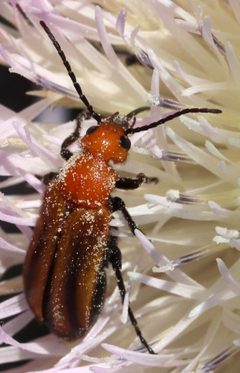
1Nemognatha piazata is a blister beetle in the Meloidae, commonly known as the Orange Blister Beetle. It is native to North America and belongs to the distinctive Nemognathinae, whose members possess elongated mouthparts adapted for feeding on flower nectar. The was described by Fabricius in 1798 and includes three recognized : N. p. piazata, N. p. bicolor, and N. p. palliata.
Pronunciation
How to pronounce Nemognatha piazata: /nɛˌmoʊˈnæθə piˈeɪzətə/
These audio files are automatically generated. While they are not always 100% accurate, they are a good starting point.
Identification
of Nemognatha piazata can be distinguished from other Nemognatha by their characteristic orange coloration. Members of the are further distinguished from other blister beetles by their greatly elongated , which form a -like structure used for accessing nectar in flowers with deep corollas. The three differ in color pattern: N. p. piazata (the nominate form), N. p. bicolor (described by LeConte, 1853), and N. p. palliata (described by LeConte, 1853).
Images
Distribution
North America. Specific records include northwestern Oklahoma, where it has been observed in shortgrass prairie with oak/pine/juniper woodland.
Behavior
are and frequently observed on flowers of yellow composite plants (Asteraceae). Like other Nemognathinae, they possess elongated, bristle-covered that transport nectar via capillary action rather than suction.
Ecological Role
are that feed on floral nectar and pollen. Larvae of Nemognathinae are typically or , though specific details for N. piazata are not documented.
Similar Taxa
- Nemognatha nigripennisSimilar flower-visiting and preferences; distinguished by darker coloration and different wing pigmentation.
- Nemognatha luteaCongeneric with overlapping distribution; distinguished by yellow coloration and different subspecific classification.