
Meloe impressus
Kirby, 1837
blister beetle, oil beetle
Meloe impressus is a of blister beetle in the Meloidae, native to North America. It belongs to a commonly known as oil beetles, characterized by their defensive secretion of , a potent blistering agent. The species is recorded across western and central Canada and the United States. Like other Meloe species, it likely exhibits the complex involving parasitic larvae that exploit solitary bees as , though specific details for this species remain poorly documented.


Pronunciation
How to pronounce Meloe impressus: /ˈmɛloʊ ˈɪmˌprɛsəs/
These audio files are automatically generated. While they are not always 100% accurate, they are a good starting point.
Identification
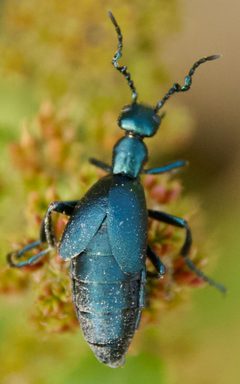
Distinguished from other Meloe by the combination of: pronotum distinctly narrower than elytral base with impressed or depressed lateral margins; short, exposing most of abdominal tergites; and overall black coloration with subtle metallic sheen. Males may be distinguished from females by their relatively narrower and modified . Accurate identification to species within Meloe typically requires examination of genitalic structures and comparison with reference specimens.
Images
Appearance
are large, robust beetles with a rounded, somewhat humpbacked profile. The are notably short, leaving much of the exposed—giving the appearance of an "ill-fitting waistcoat." The body is typically black with a slight blue or green metallic sheen. Legs are relatively short and thick. The pronotum is distinctly narrower than the base of the elytra, creating a constricted "neck" appearance. are and of moderate length.
Habitat
Found in open, sunny including grasslands, meadows, and disturbed areas. Associated with wildflower-rich environments where bees forage. Often observed on bare ground or sparse vegetation where ground-nesting bees establish colonies.
Distribution
Recorded from North America, specifically across western and central Canada including Alberta, British Columbia, and Manitoba, and southward into the United States. The exact southern extent of its range within the U.S. is not well documented in available sources.
Seasonality
are active from late winter through spring, with peak activity typically March to June depending on latitude and local climate. is generally synchronized with the activity period of solitary .
Life Cycle
The follows the typical Meloe pattern: are deposited in soil, often near or within nests of ground-nesting solitary bees. First-instar larvae (triungulins) are mobile and seek out bees, attaching to visiting females and being transported to nest burrows where they consume pollen provisions and host eggs or larvae. Later instars are sedentary and -like, completing development within the host nest. Specific host records for M. impressus are not documented in available sources.
Behavior
are slow-moving and often observed on bare ground or low vegetation. When disturbed, they exhibit , exuding containing from leg joints as a chemical defense. Adults are and thermophilic, becoming active on warm, sunny days.
Ecological Role
As a nest of solitary bees, the influences and may affect pollination services locally. production makes unpalatable to most vertebrate , contributing to their chemical defense .
Human Relevance
Can be a nuisance in gardens and agricultural settings where feed on foliage. The content poses a risk to livestock if beetles are accidentally baled in hay—cantharidin is toxic to horses and other animals. Handling adults can cause skin blistering in humans. Historically related to the "Spanish fly" medicinal tradition through -level production of cantharidin, though M. impressus itself is not a source of commercial cantharidin extraction.
Similar Taxa
- Meloe nigerSimilar black coloration and short , but differs in pronotal shape and male antennal structure; ranges overlap in parts of North America
- Meloe americanusAnother North American oil beetle with comparable size and habits; requires genitalic examination for reliable separation
- Epicauta speciesDifferent of blister beetles with fully developed covering the , more elongate body form, and different larval ( rather than )
More Details
Voucher specimens
The Entomology Research Museum at UC Riverside holds 134 specimens of M. impressus as of 2010, indicating it is a relatively well-collected within the Meloe in North America.
Research context
While the congeneric Meloe franciscanus has been intensively studied for its chemical mimicry of , M. impressus has not been subject to comparable research on - chemical .
Sources and further reading
- BugGuide
- Wikipedia
- GBIF taxonomy match
- iNaturalist taxon
- NCBI Taxonomy
- Meloidae Holdings | Entomology Research Museum
- The Amazing Bee-Parasite Research of Leslie Saul-Gershenz | Bug Squad
- Ground nesting bees beware of blister beetles - Meloe spp. — Bug of the Week
- Blistering beetles - Meloe spp. — Bug of the Week
- Springing into action – oil beetles and citizen science! - Buglife Blog - Buglife