
Epicauta pensylvanica
(De Geer, 1775)
black blister beetle, black aster bug
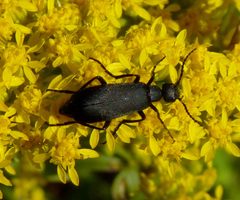
Epicauta pensylvanica is a blister beetle in the Meloidae, commonly known as the black blister beetle or black aster . The species is characterized by its predominantly black coloration and is known to contain the defensive compound , which can cause skin blistering upon contact. are typically found on flowers of plants in the Asteraceae family, particularly snakeweed (Gutierrezia sarothrae). The species occurs across North America and has been documented as a pest of soybean foliage in agricultural settings.


Pronunciation
How to pronounce Epicauta pensylvanica: /ˌɛpɪˈkaʊtə ˌpɛnsɪlˈvænɪkə/
These audio files are automatically generated. While they are not always 100% accurate, they are a good starting point.
Identification
The all-black or nearly all-black coloration distinguishes E. pensylvanica from many that display prominent yellow or gray stripes or spots. It may be confused with E. funebris, which also tends toward dark coloration, but E. pensylvanica typically lacks the distinct pale markings found on the pronotum and of that . The species can be separated from dark soldier beetles (Cantharidae) by the being wider than the pronotum and the more cylindrical body form. Final identification requires examination of male genitalia or association with plants and geographic range.
Images
Appearance
are elongate, soft-bodied beetles approximately 12–15 mm in length. The body is predominantly black with a somewhat velvety texture. The is wider than the pronotum, and the are relatively long and thread-like. The are flexible and may show subtle longitudinal striations. The overall body form is typical of Epicauta blister beetles, with a somewhat cylindrical shape that tapers slightly toward the .
Habitat
Open including prairies, grasslands, and agricultural fields. are frequently associated with flowering plants, particularly in the Asteraceae . The is often found in areas with abundant snakeweed (Gutierrezia sarothrae) and related composite flowers. Larval habitat is poorly documented but likely involves soil-dwelling on pods, as is typical for Epicauta species.
Distribution
Widely distributed across North America, with records from the United States and Canada. The has been documented from the Great Plains through the Midwest and into the northeastern United States. GBIF records indicate presence in Middle America and North America. Specific state records include Oklahoma, where it has been collected in shortgrass prairie .
Seasonality
are active primarily from late spring through early fall, with peak activity during summer months. In Oklahoma, adults have been observed in October. The likely has a single per year, with adults emerging in late spring and persisting until frost.
Diet
feed on foliage and flowers of various plants, with particular association to Asteraceae. Documented feeding on Gutierrezia sarothrae (snakeweed) flowers and soybean foliage. Larvae are , feeding on pods in the soil.
Host Associations
- Gutierrezia sarothrae - food plantFrequently observed on flowers; primary 'black aster ' derives from this association
- Glycine max - pestDocumented as defoliator of soybean in agricultural settings
- Asteraceae - food plant General association with composite flowers
Life Cycle
Complete with hypermetamorphic larvae typical of Meloidae. are laid in soil. First instar larvae (triungulins) are mobile and seek out egg pods. Subsequent larval instars are -like and feed within egg pods. occurs in soil. emerge in late spring. Detailed studies specific to E. pensylvanica are lacking; the above is inferred from the Epicauta.
Behavior
are and frequently observed on flowers, where they feed on pollen and nectar. When disturbed, adults may exude from leg joints and body segments as a chemical defense. The has been documented moving en masse into soybean fields from field margins late in the season. Adults are capable of and may aggregate on preferred plants.
Ecological Role
function as herbivores and on wildflowers. The is a documented pest of soybean, capable of causing significant defoliation when are high. Larvae serve as agents of grasshoppers through on pods. The chemical defense () makes adults unpalatable to many , potentially contributing to Müllerian mimicry complexes with similarly colored beetles.
Human Relevance
Agricultural pest of soybean, particularly in the eastern United States. The can cause rapid defoliation when move en masse from field margins. Blistering chemical defense poses minor hazard to humans handling specimens; can cause skin irritation and blistering. No documented veterinary importance from this specific species, though related blister beetles are of concern in hay fed to horses.
Similar Taxa
- Epicauta funebrisAlso predominantly black, but typically shows distinct pale pronotal and elytral markings absent in E. pensylvanica
- Chauliognathus basalisColorado soldier beetle with similar black-and-orange pattern in Müllerian mimicry complex; distinguished by more parallel-sided body form and not wider than pronotum
- Epicauta vittataStriped blister beetle with prominent yellow and black longitudinal stripes; more distinctly marked than typically dark E. pensylvanica
More Details
Nomenclatural note
The name is sometimes spelled with a double 'n' as 'Epicauta pennsylvanica', though the original spelling 'pensylvanica' is generally accepted. The specific epithet refers to Pennsylvania, the type locality.
Chemical defense
Like all Meloidae, E. pensylvanica contains , a terpenoid compound that causes blistering of skin and mucous . The compound is produced by the and serves as an effective defense against vertebrate .
Collection records
The Entomology Research Museum at the University of California, Riverside holds 329 specimens of E. pensylvanica as of 2010, indicating it is among the more commonly collected Epicauta in North America.
Sources and further reading
- BugGuide
- Wikipedia
- GBIF taxonomy match
- iNaturalist taxon
- NCBI Taxonomy
- Meloidae Holdings | Entomology Research Museum
- Portrait of a Yellowjacket | Bug Squad
- Soybean Insects: Early-to-Late Season Pests (Emergence to R7) - AgriLife Extension Entomology
- Insecta | Beetles In The Bush | Page 3
- Archive — Bug of the Week
- Bug Eric: A Beetle Mimicry Complex