
Epicauta vittata
(Fabricius, 1775)
striped blister beetle, old-fashioned potato beetle
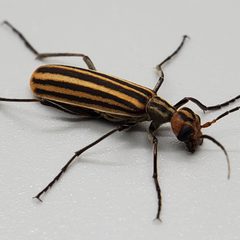
Epicauta vittata is a blister beetle native to eastern North America, known for its distinctive black and yellow striped coloration and its status as a significant agricultural pest. feed voraciously on a wide range of crop plants, particularly solanaceous , and are capable of forming dense that move en masse through fields. The species contains , a toxic terpenoid that poses serious health risks to livestock, particularly horses, when beetles are accidentally consumed in hay. The complex includes a mobile triungulin larval stage that parasitizes before becoming a sedentary .
Pronunciation
How to pronounce Epicauta vittata: //ˌɛpɪˈkaʊtə vɪˈtɑːtə//
These audio files are automatically generated. While they are not always 100% accurate, they are a good starting point.
Identification
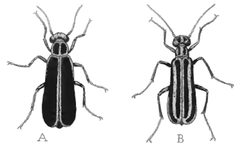
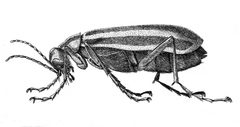
The combination of an elongated body with narrower than and , black ground color with yellow stripes, and head wider than neck distinguishes this from other beetles commonly found in agricultural settings. In northern , two elytral stripes; in southern populations, three stripes. The striped pattern separates it from uniformly colored Epicauta species. When sampling alfalfa, the distinctly wider head relative to the neck immediately separates blister beetles from other common beetles.
Images
Habitat
Agricultural fields, particularly alfalfa, soybean, and other legume crops; also found in areas with solanaceous plants and weedy field margins. are attracted to blooming fields and congregate on flowers.
Distribution
Eastern North America, including eastern Canada (Ontario, Québec) and the eastern United States. Records indicate presence throughout this range with varying regionally.
Seasonality
are most abundant during summer months, with peak activity in the morning and late afternoon hours. During midday heat, adults seek shelter in the or become inactive. In hot, dry climates, activity may shift primarily to evening hours. One or two per year depending on climate.
Diet
feed on foliage, flowers, and fruits of numerous plants. Preferred are solanaceous plants (Solanaceae), including potato, tomato, eggplant, and pepper. Also feeds on amaranths (Amaranthus spp.), beans, beet, carrot, cabbage, corn, pea, radish, spinach, squash, sweet potato, turnip, clover, soybean, and alfalfa. Larvae are of , specifically targeting that produce large egg-pods such as Melanoplus bivittatus (two-striped grasshopper) and Melanoplus differentialis (differential grasshopper).
Host Associations
- Solanaceae - food plantpreferred including potato, tomato, eggplant, pepper
- Amaranthus spp. - food plant
- Glycine max - food plantsoybean
- Medicago sativa - food plantalfalfa
- Melanoplus bivittatus - larval two-striped grasshopper; larval development occurs in -pods
- Melanoplus differentialis - larval differential grasshopper; larval development occurs in -pods
Life Cycle
Females deposit in masses of 100–200 in tubular chambers a few centimeters deep in soil, covering them afterward. Eggs are whitish, approximately 2 mm long, and hatch within 16 days. First instar larvae (triungulins) possess functional legs and actively seek . Upon locating a egg pod, the larva enters and feeds, becoming a sedentary with reduced legs. Development continues through several instars within the egg case. occurs in soil. One or two per year depending on local climate conditions.
Behavior
are with bimodal activity peaks in morning and late afternoon, seeking shelter during midday heat. Capable of forming dense or 'swarms' that move en masse through fields. When disturbed, adults emit body fluids containing from leg joints as a chemical defense. Adults are highly mobile and can rapidly colonize blooming fields.
Ecological Role
Larval stage functions as a of , potentially providing some of grasshopper . are significant herbivores in agricultural . The serves as prey for robber flies and several bird species including western meadowlark, eastern bluebird, and scissor-tailed flycatcher. Eggs are subject to by the related blister beetle Epicauta atrata.
Human Relevance
Major agricultural pest causing direct damage through defoliation and fruit injury. are particularly problematic due to aggregating and preference for crop plants. Contains , a toxic terpenoid that causes severe blistering of skin and mucous ; ingestion by livestock, especially horses, can be fatal. The cantharidin content of E. vittata is among the highest recorded for blister beetles (up to 5.4% dry weight). of hay with as few as 30–50 beetles can be lethal to horses. The is a significant concern for hay producers and horse owners in eastern North America. May bean pod mottle virus in soybean.
Similar Taxa
- Epicauta atrataOverlapping distribution and similar use; distinguished by color pattern and (E. atrata preys on E. vittata )
- Other Epicauta speciesMany Epicauta share similar body form and occur in same ; E. vittata distinguished by specific black and yellow striped pattern with geographic variation in stripe number
- Other Meloidae in alfalfaUniformly gray or black occur in same ; E. vittata distinguished by striped pattern and wider than neck
Misconceptions
Claims that a single can kill a human are likely exaggerated; calculations based on reported content suggest approximately 100 beetles would be required for a lethal dose to a 1000-lb horse, though individual sensitivity varies and smaller individuals or children would be at greater risk.
More Details
Cantharidin toxicity
content has been reported at 0.31–1.45 mg per in small , and approximately 4–5 mg in general. The toxic dose in horses is about 1 mg per kg body weight. of cantharidiasis include oral blisters and ulcers, pawing, stretching, diarrhea containing intestinal mucosa, hypocalcemia, and hypomagnesemia. Cattle and sheep appear less susceptible but can exhibit symptoms.
Management in alfalfa
Risk of blister beetle is generally lower in first cutting. Monitoring should begin at least one week before cutting and continue through baling. Cutting before or at 5% bloom reduces risk. Removing crimper devices from swathers allows living beetles to escape windrows before baling. Raking hay before baling can dislodge dead beetles.
Sources and further reading
- BugGuide
- Wikipedia
- GBIF taxonomy match
- iNaturalist taxon
- Meloidae Holdings | Entomology Research Museum
- Soybean Insects: Early-to-Late Season Pests (Emergence to R7) - AgriLife Extension Entomology
- Alfalfa Insects - AgriLife Extension Entomology
- Meloidae | Beetles In The Bush | Page 3
- predator avoidance | Beetles In The Bush | Page 7
- mimicry | Beetles In The Bush | Page 4
- Redefinition of the vittata species group of Epicauta Dejean (1834) (Coleoptera: Meloidae) and taxonomic revision of the species from southern South America