
Stenus pubescens
Stephens, 1833
Stenus pubescens is a of rove beetle in the Staphylinidae, Steninae. It is one of numerous species in the large Stenus, which is characterized by distinctive adaptations including the ability to glide on water surfaces using specialized gland secretions. The species has a Holarctic distribution, occurring across much of Europe, northern Asia, and North America. Like other members of the genus, it is a of small .
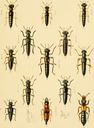
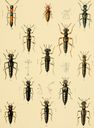
Pronunciation
How to pronounce Stenus pubescens: /ˈstɛ.nəs pjuːˈbɛs.ɛnz/
These audio files are automatically generated. While they are not always 100% accurate, they are a good starting point.
Images
Habitat
Found in moist near water, including stream margins, lake shores, and wet meadows. Members of the Stenus are typically associated with riparian zones and other areas where water gliding can be utilized.
Distribution
Holarctic distribution: Europe (29 countries), Russia (European, Siberia, Far East), Kazakhstan, Mongolia, Japan (Hokkaido), China (Heilongjiang), Canada (Alberta, British Columbia, Manitoba, New Brunswick, Newfoundland, Northwest Territories, Ontario, Quebec, Saskatchewan, Yukon), and USA (Alaska, Arizona, Colorado, Idaho, Michigan, South Dakota, Utah, Wyoming). A record from Turkey is considered erroneous.
Diet
of small , particularly collembola (springtails) and other minute arthropods found in leaf litter and moist ground layers.
Behavior
Exhibits the characteristic water-gliding of the Stenus, enabled by specialized gland secretions that reduce surface tension. This allows the to move rapidly across water surfaces to capture prey or escape . Like other Stenus , it likely uses a specialized hunting technique involving eversion of mouthparts to capture prey.
Ecological Role
in moist terrestrial and semi-aquatic microhabitats, contributing to regulation of small in leaf litter and riparian zones.
Similar Taxa
- Other Stenus speciesMany Stenus are superficially similar in body form and share the characteristic water-gliding . Identification to species level requires examination of subtle morphological characters including details of the , punctation patterns, and precise body proportions.
- Dianous speciesMembers of the related Dianous also exhibit water-gliding and occupy similar , but differ in body form and details of the glandular apparatus used for surface tension reduction.
More Details
Taxonomic Note
Catalogue of Life lists this name as an ambiguous synonym, suggesting some taxonomic uncertainty or potential confusion with other names in the literature. GBIF and NCBI treat it as an accepted . The subgeneric placement within Stenus (Metatesnus) has been proposed but may not be universally accepted.