
Stenus
rove beetles, water-gliding rove beetles
Species Guides
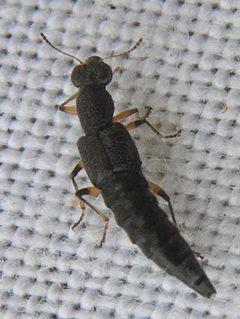
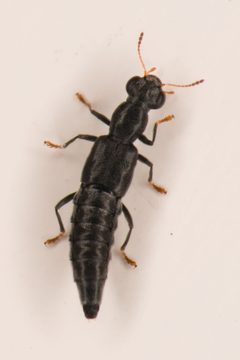
30Stenus is a of semiaquatic rove beetles comprising approximately 3100 described , making it one of the largest genera in the animal kingdom. These beetles are of small arthropods, particularly Collembola. They possess distinctive adaptations including a protrusible adhesive for prey capture and pygidial gland secretions that enable rapid water surface locomotion via the Marangoni effect. The genus occurs worldwide across diverse from aquatic margins to terrestrial leaf litter.

Pronunciation
How to pronounce Stenus: /ˈstiː.nʊs/
These audio files are automatically generated. While they are not always 100% accurate, they are a good starting point.
Identification
Stenus are distinguished from other Steninae by their partially developed water-gliding ability, in contrast to the fully aquatic Dianous where all species exhibit this trait. Within Stenus, species vary in preference: some inhabit shorelines and demonstrate water-gliding , while others occupy leaf litter and lack this ability. The genus is characterized by a protrusible with paraglossae bearing adhesive pores, though this feature requires microscopic examination for definitive identification. Stenus species generally possess the slender body form typical of Staphylinidae with relatively short exposing most of the .
Images
Habitat
range from semiaquatic environments including shorelines and water margins to terrestrial leaf litter. Some occupy moist forest floor habitats where Collembola are abundant. The shows ecological flexibility with species adapted to different moisture regimes, from fully terrestrial to marginally aquatic settings.
Distribution
Worldwide distribution with documented across multiple continents. The has been recorded from China (including Ningxia Autonomous Region), Europe, and other regions. Specific distribution varies by species, with some showing restricted ranges while others are more widespread.
Diet
of Collembola and other small arthropods. Prey capture involves use of a protrusible with adhesive paraglossae that immobilizes prey, or direct mandibular capture for prey with , setae, or large body size.
Behavior
Two distinctive characterize the : prey capture and water surface locomotion. The can be protruded at high speed (1-3 milliseconds in Stenus comma) using pressure and withdrawn rapidly (30-40 milliseconds) to capture prey. Some exhibit "skimming" behavior on water surfaces using pygidial gland secretions as to propel forward via the Marangoni effect, achieving velocities up to 0.75 m/s and covering distances up to 15 meters with continuous secretion. Water-gliding ability varies among species and is -dependent.
Ecological Role
that regulate of Collembola and other small soil arthropods in leaf litter and shoreline . Their specialized predatory adaptations contribute to trophic dynamics in moist terrestrial and semiaquatic .
Similar Taxa
- DianousBoth belong to Steninae and share the protrusible prey capture mechanism. Dianous are fully aquatic and all exhibit water-gliding ability, whereas Stenus shows partial development of this trait with some species lacking it entirely. Dianous is consistently associated with water , while Stenus occupies a broader ecological range including terrestrial leaf litter.
More Details
Labium mechanics
The protrusible consists of a thin rod ending in paraglossae—pads with bristly hairs and hooks. Small pores between these hairs exude an adhesive substance. This mechanism is ineffective against prey with , setae, or large size, which are instead captured by direct lunge-and-grab using .
Species diversity
With approximately 3100 described , Stenus rivals Agrilus as one of the largest in Animalia. New species continue to be described, with recent discoveries from underexplored regions such as Ningxia, China.